Tier II & Biennial Hazardous Waste Reporting Requirements by State
Tier II and Biennial/Annual reports are regulatory requirements for organizations that generate hazardous waste or store hazardous materials—but reporting guidelines vary from state to state, complicating compliance. Review our analysis of the Tier II & Biennial Hazardous Waste reporting requirements by state to ensure reporting success.
*Please note: This guidance is intended as an informational resource and should not be considered a comprehensive summary of all applicable compliance requirements. Because requirements may change without notice, contact a Triumvirate Environmental representative for the most current information.
Tier II & Biennial Hazardous Waste Reporting Requirements By State
Tier II Reporting
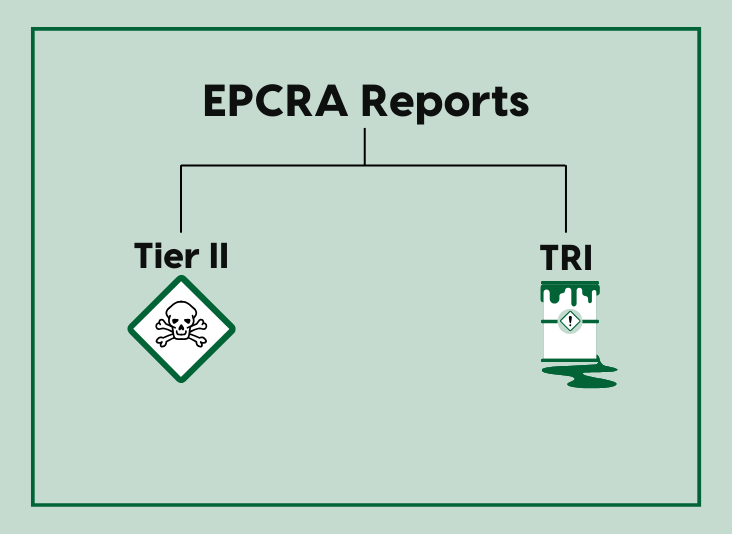
Tier II reports are mandatory under the Environmental Protection Agency's (EPA's) Emergency Planning and Community Right-to-Know Act (EPCRA) (also known as the Superfund Amendment Reauthorization Act (SARA) Title III). These reports must be filed by US organizations that store hazardous chemicals in amounts exceeding specified thresholds; equal to or exceeding 10,000 pounds of specific Threshold Planning Quantities (TPQs) for Extremely Hazardous Substances (EHSs). These reports must be submitted annually by March 1.
Review Tier II EPCRA reporting requirements by state below.
More information can be found on the Environmental Protection Agency's (EPA's) State Tier II Reporting Requirements and Procedures webpage.
Alabama Tier II reporting thresholds do not differ from the federal thresholds.
There are two options for filing:
-
Via Tier2 Submit by emailing the .t2s file to AL312@adem.alabama.gov.
This fulfills the reporting requirement for the Alabama Emergency Response Commission but not a Local Emergency Planning Committee (LEPC) or local fire department.
Master ID # and a valid email are state-required in the submission.
See the Alabama Department of Environmental Management (ADEM) Emergency Planning and Community Right-to-Know Act (EPCRA) webpage for more information.
Alaska Tier II reporting requirements do not differ from federal requirements.
Filing is done via E-Plan.
Site plans, a list of site coordinates, and abbreviations that correspond to buildings, lot areas, etc. are required throughout your facility in Alaska. The Alaska State Emergency Response Commission (SERC) has approved requesting shipping information on the Tier II form.
See the Alaska Tier II Reporting webpage for more information.
Arizona Tier II reporting requirements do not differ from federal requirements, but some local jurisdictions have adjusted their thresholds.
Tier II Chemical Inventory reports are completed through myDEQ, the Arizona Department of Environmental Quality's online portal. Reports must include information about the facility, hazardous chemicals, emergency contacts, and the Facility Emergency Response Plan (FERP). Some regulatory bodies may require a physical copy; this should be confirmed with the local fire department.
Reporting fees may apply.
See Arizona's Tier II Reporting webpage for more information.
Arkansas Retail Service Stations have adjusted thresholds for Tier II reporting.
Reports are filed through Hazconnect and collected by a central repository, the Arkansas Division of Emergency Management.
Visit the Arkansas Division of Emergency Management website for more details.
In California, a Hazardous Materials Business Plan (HMBP) satisfies Tier II requirements, and thresholds are lower for reporting than in the federal requirements. HMBPs are required if a site has 500 gallons of a hazardous liquid, 500 pounds of a hazardous solid, or 200 cubic feet of a compressed gas.
Some counties or cities have lower thresholds and earlier reporting deadlines.
Reporting is done through the California Environmental Reporting System (CERS).
Colorado thresholds map to the federal requirements but additional steps are needed for submission:
-
Prepare the report in the Environmental Protection Agency's (EPA's) Tier2 Submit software
- Upload and submit the report to the Colorado Department of Public Health and Environment (CDPHE) using AccessGov
A Dun and Bradstreet number is needed for submission.
Visit Colorado's Tier II hazardous chemical inventory reporting webpage for more information.
Connecticut thresholds do not differ from federal requirements, but Connecticut state-run facilities are bound by state statutes (CGS Sec. 22a-609 and 22a-610) and Conn-OSHA rules, whereas federal OSHA definitions traditionally exclude public state employees. The Connecticut Department of Energy and Environmental Protection (CT DEEP) manages the Emergency Planning and Community Right-to-Know Act (EPCRA) data for the State Emergency Response Commission (SERC).
Connecticut organizations can submit the report through Hazconnect to satisfy Connecticut Department of Energy and Environmental Protection and State Emergency Response Commission guidelines. Organizations may also submit through Tier2 Submit via email attachment to DEEP.CTEPCRA@ct.gov.
They must also manually distribute hard or electronic copies of the certified report, site plan, and safety data sheets (SDSs) directly to their Local Emergency Planning Committee (LEPC) and local fire department.
Visit Connecticut's SERC website for more information.
Delaware Tier II thresholds are 55 gallons or 500 pounds (whichever is lower) for Hazardous Chemicals. This also applies to Extremely Hazardous Substances (EHSs).
Reporting is done through the Tier II Manager system.
Visit Delaware's Tier II website for more information.
DC Tier II thresholds do not differ from the federal requirements.
Reports must be submitted electronically via the Homeland Secutiry and Emergency Management Agency (HSEMA) Online Tier II Manager database after registering on the DC Hazconnect website. HSEMA acts as both the State Emergency Response Commission (SERC) and the Local Emergency Planning Committee (LEPC) for the District.
View the HSEMA website for more information.
Florida Tier II requirements do not differ from federal requirements, but all Tier II maximum amounts need to be listed in pounds not range codes.
Organizations should file reports using E-Plan which satisfies State Emergency Response Commission (SERC) and Local Emergency Planning Committee (LEPC) needs, but organizations should check the needs of local fire departments.
Fees will apply.
See the Florida Emergency Planning and Community Right-to-Know Act (EPCRA)/Tier II webpage for more information.
Georgia Tier II requirements do not differ from the federal requirements. Local Emergency Planning Committees (LEPCs) and local fire departments may have additional notification requirements specific to their jurisdiction.
Organizations must file reports through E-Plan.
For more information, visit the Georgia Environmental Protection Division website.
Hawaii organizations should prepare Tier II reports with Tier2Submit software and submit reports through the Hawaii Department of Health ePermitting System.
Hard copies are an option but not preferred by the state.
Each facility must enter its state-issued unique Hawaii Tier 2 Facility ID in the submission.
Visit the Hawaii Emergency Planning and Community Right-to-Know Act (HEPCRA) Tier II report webpage for more information.
Idaho Tier II reporting requirements do not vary from federal requirements.
To satisfy State Emergency Response Commission (SERC) requirements, electronic .t2s files should be mailed to the Idaho Office of Emergency Management (IOEM) at tier2@imd.idaho.gov. Check for further instructions from the Local Emergency Planning Committee (LEPC) and local fire department.
See the Idaho Tier II Reporting webpage for more information.
Illinois Tier II reporting requirements do not differ from the federal requirements.
Reports are submitted through the Tier II Manager On-Line Hazconnect Filing System to satisfy Illinois Emergency Management Agency and Office of Homeland Security (IEMA-OHS) requirements. Special electronic copies (like Chicago's CP3) must be mailed directly to the county's Local Emergency Planning Committee (LEPC) and local fire deparment.
For more information, visit the Illinois State Emergency Response Commission (SERC)/LEPC/Tier II Reporting webpage.
Indiana Tier II requirements do not differ from federal requirements.
Reports are submitted through Tier II Manager, also known as Hazconnect. Submission satisfies Indiana Department of Homeland Security (IDHS), Indiana Department of Environmental Management (IDEM), Local Emergency Planning Committee (LEPC), and local fire department requirements.
For more information, visit the Indiana Department of Homeland Security's (IDHS's) Emergency Planning and Community Right-to-Know Act (EPCRA) webpage.
Iowa Tier II reporting requirements do not differ from federal requirements.
Organizations should use E-Plan to report. For Local Emergency Planning Committee (LEPC) compliance, check the specific county's preferred submission method on the Iowa Department of Natural Resources County Coordinator List and contact your local fire department.
Iowa requires two Emergency Contacts to be listed on the report.
For more information, visit Iowa's Chemical Inventory Reporting webpage.
Kansas Tier II thresholds are aligned with federal thresholds, but there are specific volume guidelines for retail fuel stations.
Organizations need to submit an additional online certification letter and fee worksheet. Facilities are responsible for generating copies of their report and manually submitting them directly to their county Local Emergency Planning Committee (LEPC) and local fire department/district with jurisdiction.
Reports are filed through the Kansas Department of Health and Environment's own Tier II Online Reporting platform.
For more information, visit the Kansas Community Right-to-Know webpage.
Kentucky Tier II reporting requirements do not differ from federal requirements.
Organizations should report through the Hazconnect Tier II Reporting system for compliance with the Kentucky Emergency Response Commission, Local Emergency Planning Committees (LEPCs), and local fire departments. There may be required fees.
More information can be found on the Kentucky Emergency Response Commission website.
Louisiana's reporting thresholds are more stringent than the federal requirements. Under state rules, the threshold quantities which trigger inventory reporting are 500 pounds of a chemical present onsite on any one day during the preceding calendar year, except for some Extremely Hazardous Substances (EHSs) with lower threshold quantities.
Louisiana organizations must first file online via theLouisiana State Police Tier II Inventory Filing website. Then, copies must be sent directly to the Local Emergency Planning Committee (LEPC) of the parish where the facility is located and the fire department that has jurisdiction over the facility. The LEPC requires a hard copy, and it is recommended to contact local fire departments to determine if a hard copy is needed.
For more information, see the Louisiana Tier II Electronic Filing website.
Maine Tier II reporting requirements do not vary from federal requirements.
Submission is done via the Tier2 Submit software, but organizations are required to deliver appropriate documentation to the LEPC and local fire department independently.
Maine charges an annual State Emergency Response Commission (SERC) registration and inventory fee.
Montgomery County Local Emergency Planning Committee (LEPC) has different threshold requirements for hazardous substances; the rest of Maryland does not differ from the federal Tier II guidance.
Reports must be filed through the Maryland Online Tier II Reporting System (MOTTRS); submissions go to the State Emergency Response Commission (SERC), the LEPC, and the local fire department.
For more information, see the Maryland Online Tier II Reporting System webpage.
Massachusetts Tier II requirements do not differ from the federal guidance.
Submission is done via Hazconnect, which satisfies the State Emergency Response Commission (SERC). Massachusetts organizations are also required to submit separate copies to their Local Emergency Planning Committee (LEPC) and local fire department.
More information can be found on the Massachusetts State Emergency Response Commission webpage.
Michigan Tier II requirements do not differ from the federal requirements.
Reports should be filed via the Tier II Manager Hazconnect portal. The system automatically provides real-time access to state officials, county-level Local Emergency Planning Committees (LEPCs), and participating emergency management agencies.
View the Michigan Emergency Planning and Community Right-to-Know webpage for more information.
Minnesota Tier II requirements do not differ from the federal guidance.
In Minnesota, the Tier II Manager Hazconnect system, specifically the Minnesota state-specific form, is utilized for electronic Tier II submissions. This platform distributes the inventory report to the necessary state and local emergency contacts, including the State Emergency Response Commission (SERC), Local Emergency Planning Committees (LEPCs), and local fire departments.
Missouri Tier II reporting guidelines do not differ from the federal requirements, except for Explosives and Blasting Agents for which reporting thresholds are stricter than the federal baseline at 100 lbs.
Submissions are done through the Missouri Tier II Electronic Filing Tool. The report can be sent to the Local Emergency Planning Committee (LEPC) and local fire department for an optional $10 distribution fee.
For more information, visit the Missouri Emergency Response Commission Tier II webpage.
Montana Tier II reporting guidelines do not differ from the federal requirements.
The Montana Department of Environmental Quality (DEQ) and State Emergency Response Commission (SERC) require filing through E-Plan. Local fire departments and the Local Emergency Response Committee (LEPC) may require additional separate submissions. Hard copies are not accepted.
No fees are required.
For more information, visit Montana's Tier II Reporting webpage.
Nebraska Tier II requirements do not differ from the federal guidance.
Submission is done through the Nebraska Department of Water, Energy, and Environment (DWEE) Tier II system.
For more information, see the Nebraska DWEE Tier II System webpage.
Nevada Tier II requirements do not differ from the federal guidance, except that the state also requires compliance with International Fire Code (IFC) regulations.
The State Fire Marshal manages Tier II submissions, and charges a permit fee and facility surcharge. In some counties, Tier II submission actually doubles as a State Fire Marshal operating permit. The State Emergency Response Commission (SERC) charges a base fee plus a tonnage fee for Extremely Hazardous Substances (EHSs). Reports will also need to be submitted to the Local Emergency Planning Committee (LEPC) and local fire department.
Reporting is done through the Nevada Online Hazardous Materials Reporting System.
Dun & Broadstreet number will be required in report submission.
For more information, see the Nevada Division of Environmental Protection webpage.
New Hampshire Tier II requirements do not differ from the federal guidance.
Reporting is done through the NH Tier II Portal, managed by the NH State Fire Marshal's Office. Organizations are also required to submit Tier II reports to their local fire department and the Local/Regional Emergency Planning Committee (L/REPC).
See the New Hampshire Tier II Portal webpage for more information.
New Jersey facilities are subject to the New Jersey Environmental Hazardous Substance (EHS) list which contains thresholds that are lower than federal thresholds:
- 500 pounds if reportable quantity (RQ) is not listed
- 10,000 pounds if chemical is not listed
Submission of these reports, also called Community Right-to-Know reports, through the eCRTK Survey is required by the New Jersey Department of Environmental Protection. Facilities may also need to manually provide copies of their reports to their county-level Local Emergency Planning Committee (LEPC) and local fire departments.
See the New Jersey Community Right-to-Know webpage for more information.
New Mexico must facilities create Tier II reports through Tier2 Submit and email the files to HAZMAT@SHSEM.NM.gov. Alternative submission options are available for larger reports.
Facilities are not required to send the report directly to their Local Emergency Planning Committee (LEPC) or local fire department unless a specific local agency maintains a separate local requirement.
Fees are calculated based on the number of chemicals at the facility.
For more information, visit the New Mexico Tier 2 webpage.
New York State:
New York State Tier II requirements do not differ from federal guidance.
E-Plan should be used to file Tier II reports to satisfy state requirements. Fire Departments and Local Emergency Planning Committees (LEPCs) may require copies of the report; the decision to accept online reporting for LEPCs and local fire departments is dependent on the jurisdiction.
New York City:
New York City's reporting thresholds are more stringent than the federal thresholds.
Facilities in New York City must file a separate local Tier II/Facility Inventory Form (FIF), submitted to the New York City Department of Environmental Protection, to be compliant with New York City Local Law 26/88 and Community Right-to-Know requirements.
For more information, see New York's Tier II Reporting website.
North Carolina enforces the following thresholds: 55 gallons, 500 pounds, or the federal threshold, whichever is lower or most applicable under the state Right-to-Know Act.
The State Emergency Response Commission (SERC), fire departments, and emergency planning committees accept reports via E-Plan.
State fees may be applicable.
For more information, visit North Carolina's Emergency Planning and Community Right-to-Know (EPCRA) Tier 2 webpage.
North Dakota Tier II requirements do not differ from the federal guidelines.
Reports are submitted through Hazconnect; verify with the North Dakota Department of Emergency Services (NDDES), Division of Homeland Security, Local Emergency Planning Committee (LEPC), and local fire department if additional submissions are required.
See the North Dakota Haz-Chem Preparedness and Response webpage for more information.
Ohio Tier II requirements do not differ from the federal guidance.
Ohio mandates reporting via Tier2 Submit; files can be submitted to the Ohio State Emergency Response Commission (SERC) as a .t2s file on a flash drive or by email to both SERC@epa.ohio.gov and the Local Emergency Planning Committee (LEPC). A site map must also be sent to the local fire department.
For more information, please see the Ohio SERC webpage.
Oklahoma Tier II report requirements do not differ from the federal guidance.
Reports should be prepared with Tier2 Submit then send to the Oklahoma Department of Environmental Quality (DEQ) via a specialized internet collection utility. The DEQ sends reports to Local Emergency Planning Committees (LEPCs) and local fire departments.
Visit the Oklahoma Tier II Reporting webpage for more information.
Oregon Tier II reporting thresholds are lower than federal Tier II reporting thresholds.
These reports, also called Community Right-to-Know (CR2K) reports, require a detailed site diagram. They must be submitted via Hazconnect, also known as CHS Manager, to the Oregon State Fire Marshal (OSFM).
See the Oregon Community Right-to-Know webpage for more information.
Pennsylvania Tier II reporting requirements do not differ from the federal guidance.
Reports are submitted through the Pennsylvania Tier II System (PATTS), also known as Hazconnect.
Facilities are still required to ensure copies reach their county-level Local Emergency Planning Committee (LEPC) and responding local fire department.
For more information, visit the Tier II Reporting and PATTS webpage.
Puerto Rico Tier II reporting thresholds match the federal guidance, but the submittal process differs.
In Puerto Rico, Tier II reports must be prepared via Tier2 Submit and the zip file, on a 3.5" diskette or CD, and a cover letter should be mailed to the Puerto Rico State Emergency Response Commission (PR SERC).
Printed copies should be mailed to the Local Emergency Planning Committee (LEPC) and local fire department.
No fees are required for submission.
For more information, visit the Puerto Rico Department of Natural and Environmental Resources (DNER) website.
Rhode Island Tier II requirements do not differ from the federal guidance.
Facilities in Rhode Island should prepare reports with Tier2 Submit then submit files electronically to DEM.TIER2@dem.ri.gov. Copies of the Tier II Annual Inventory Form must also be sent to the local municipal fire department and the Local Emergency Planning Committee (LEPC) District Chairperson.
For more information, visit the Rhode Island Emergency Planning and Community Right-to-Know Act (EPCRA) webpage.
South Carolina Tier II reporting requirements do not differ from the federal guidance.
Reports are submitted via E-Plan to the South Carolina State Emergency Response Commission (SERC), Local Emergency Planning Committees (LEPCs), and fire departments. Facilities must print, sign, and keep the E-Plan submission confirmation email and PDF report onsite for five years after submission.
LEPCs and fire departments may impose separate fees.
For more information, visit the South Carolina Department of Environmental Services (SC DHEC) Tier II webpage.
South Dakota Tier II reporting requirements do not differ from the federal guidelines.
South Dakota facilities can submit Tier II reports as a hard copy or via the South Dakota Department of Agriculture and Natural Resources (DANR) Tier II reporting website. Copies should also be sent to the local fire department and Local Emergency Planning Committee (LEPC).
For more information, visit the South Dakota Superfund Amendments and Reauthorization Act (SARA) Title III webpage.
Tennessee Tier II reporting requirements do not differ from the federal guidance.
Tennessee requires facilities to submit Tier II reports via E-Plan to the State Emergency Response Commission (SERC). Paper copies may be required for submission to the Local Emergency Planning Committee (LEPC) and local fire department.
E-Plan charges $25 per facility with no additional state-imposed filing fees for Tennessee.
For more information, see the Tennessee Tier II FAQ webpage.
Texas Tier II reporting requirements do not differ from the federal guidance.
Texas facilities can file through the State of Texas Environmental Electronic Reporting System (STEERS), the Texas Commission of Environmental Quality's (TCEQ's) online Tier II application system.
Facilities must send exported copies or separate submissions to their Local Emergency Planning Committee (LEPC) and local fire department.
Filing fees may be applied.
For more information, see the Texas Tier II Reporting Requirements webpage.
Utah Tier II reporting requirements do not differ from the federal guidance.
The Utah Department of Environmental Quality (UDEQ) requires that each facility use Tier2 Submit to prepare submission, then upload the .t2s file through the UDEQ Tier 2 Submission Portal.
Tier 2 reports must also be filed with the local fire department and Local Emergency Planning Committee (LEPC).
For the application, the facility will need to enter its unique Utah Tier 2 State ID. There are currently no fees for Tier II filing.
For more information, visit the Utah Tier 2 Chemical Inventory Submission webpage.
Vermont maintains different Tier II reporting thresholds than federal guidance:
-
100 pounds or the Threshold Planning Quantity (TPQ), whichever is lower
-
10,000 pounds for petroleum products and fuels
-
Any amount of carcinogens or explosives
The report and a safety data sheet (SDS) for each reported hazardous material should be prepared via Tier2 Submit then submitted to the State Emergency Response Commission (SERC) via the Vermont SERC Tier II Submit portal; to the Local Emergency Planning Committee (LEPC) as a .t2s file to DPS.StatewideLEPC@vermont.gov; as a hard copy or via a specific format to the local fire department.
A fee may apply.
For more information, visit the Vermont Emergency Planning and Community Right-to-Know (EPCRA) Compliance webpage.
Virginia Tier II reporting requirements do not differ from the federal guidelines.
Tier II reports must be prepared using Tier2 Submit then sent to the United States Environmental Protection Agency (EPA), Virginia Department of Environmental Quality (DEQ), the Local Emergency Planning Committee (LEPC), and the local fire department.
Virginia does not charge a state fee for the filing.
For more information, see the Virginia Community Right-to-Know webpage.
Washington Tier II reporting requirements do not differ from the federal guidelines, except for higher thresholds for Retail Fuel Stations.
Reports should be filed through Tier 2 Online via the Washington State Department of Ecology's Secure Access Washington (SAW) portal.
After completing the online report, copies must be downloaded and sent to the Local Emergency Planning Committee (LEPC), local fire departments, and the Tribal Emergency Planning Committee if applicable.
There are no state fees for filing.
For more information, see the Tier Two reporting webpage.
West Virginia Tier II reporting requirements do not differ from the federal guidance.
Reporting is done through Hazconnect, formerly known as Tier II manager. The West Virginia State Emergency Response Commission (WVSERC) notifies the State Emergency Response Commission (SERC), Local Emergency Planning Committee (LEPC), and fire departments upon submission.
The filing facility may be subject to a fee.
Wisconsin Tier II reporting requirements do not differ from the federal guidance.
Reports are filed through Hazconnect, also known as the Wisconsin Hazmat Online Planning and Reporting System (WHOPRS). Hard copy submissions may also be allowed using Wisconsin-specific forms which can be found on the Wisconsin Forms and Resources webpage.
For more information, review the Wisconsin Emergency Planning and Community Right-to-Know Act (EPCRA) webpage.
Wyoming Tier II reporting requirements do not differ from the federal guidelines, with the exception of facilities that fall under Section 302 reporting requirements for Extremely Hazardous Substances (EHSs).
Wyoming facilities should prepare reports within Tier2 Submit, then submit this file through Aristatek, the Wyoming Office of Homeland Security's reporting portal.
If an organization has EHSs, they must complete an EHS worksheet and attach that to the .t2s file to be included in the submission; submission of a current Facility Emergency Response Plan that includes a site plan with EHS locations identified will fulfill this requirement as well.
For more information, visit the Wyoming Tier II webpage.
Biennial/Annual Hazardous Waste Reporting
Biennial RCRA Hazardous Waste reports require Large Quantity Generators (LQGs) to detail activities for the previous calendar year if the site generated or accumulated hazardous waste or spill clean-up materials above certain pre-determined quantities. These must be submitted regularly, either annually or biennially depending on the state, by March 1. 2026 was a biennial reporting year; 2027 is an annual reporting year.
Review RCRA Biennial Hazardous Waste Report requirements by state below.
More information can be found on the Environmental Protection Agency's (EPA's) Biennial Hazardous Waste Report webpage.
Very Small Quantity Generators (VSQGs), Small Quantity Generators (SQGs), Large Quantity Generators (LQGs), and Treatment, Storage, and Disposal Facilities (TSDFs) must submit an annual Alabama Department of Environmental Management Form 8700-12 to the state.
Biennial Hazardous Waste reporting required for LQGs and TSDFs, completed in RCRAInfo.
Small Quantity Generators (SQGs), Large Quantity Generators (LQGs), and Treatment, Storage, and Disposal Facilities (TSDFs) must submit annual notifications to the Alaska Department of Environmental Conservation (ADEC) via the Hazardous Waste Information Platform (HWIP).
Alaska LQG and TSDFs must also submit Biennial reports through RCRAInfo once the 5-year transition of submitting an annual activity report is complete.
Arizona reporting does not differ from the federal requirements.
Federal Resource Conservation and Recovery Act (RCRA) Large Quantity Generators (LQGs) must include both RCRA and non-RCRA hazardous waste in Biennial reports.
A report is required, to be filed within RCRAInfo, even if a site was an LQG for just one calendar month in the previous year.
Connecticut reporting does not differ from the federal requirements, but filing is required even if a site was an LQG for just one calendar month.
Annual reports, called RCRA Hazardous Waste Reports, are required for Large Quantity Generators (LQGs).
Reporting is done via RCRAInfo.
DC generators face reporting and self-certification requirements as well as an annual fee.
A Biennial Hazardous Waste Report is required for Large Quantity Generators (LQGs); reports are submitted through RCRAInfo. LQGs must also pay an annual Hazardous Waste Fee online or by mail by March 1.
Very Small Quantity Generators (VSQGs), Small Quantity Generators (SQGs) must also pay the annual Hazardous Waste Fee online or by mail by March 1. Additionally, these generators must file an annual Self-Certification to the Department of Energy & Environment (DOEE).
Large Quantity Generators (LQGs), Treatment, Storage, and Disposal Facilities (TSDFs), specific recyclers of Resource Conservation and Recovery Act (RCRA) hazardous waste, and facilities that meet the definition of a Reverse Distributor must submit Biennial Hazardous Waste Reports.
Reporting may be done through RCRAInfo; hard copy submissions are also acceptable.
Georgia reporting does not differ from the federal requirements.
Additionally:
- Registered LQGs that did not generate LQG quantities during 2026 must submit a Certification of Non-Filer Form and a Waste Reduction Progress Report.
- LQGs must submit a Waste Reduction Plan (WRP) to the Environmental Protection Division; if a WRP has already been submitted, LQGs must file a Progress Report biennially.
Idaho reporting does not differ from the federal requirements.
Additionally, LQGs and Small Quantity Generators (SQGs) must notify the Idaho Department of Environmental Quality (DEQ) of hazardous waste activities by January 31 annually.
Annual and Biennial Reports are required to be submitted through RCRAInfo for Treatment, Storage, and Disposal Facilities (TSDFs) as well as Large Quantity Generators (LQGs), even if the quantities exceed the threshold in one month.
Very Small Quantity Generators (VSQGs) and Small Quantity Generators (SQGs) are not required to report annually or biennially, but must re-notify the Illinois Environmental Protection Agency (EPA) of their generator status every four years by September 1 by submitting Form 8700-12.
Annual and Biennial Hazardous Waste Reports are required to be submitted through RCRAInfo for all Indiana Treatment, Storage, and Disposal Facilities (TSDFs) and for generators that reach either Small Quantity Generator (SQG) or Large Quantity Generator (LQG) status in any calendar month during the previous year.
Iowa Large Quantity Generators (LQGs) must submit Biennial Reports to RCRAInfo.
Additionally, Treatment, Storage, and Disposal Facilities (TSDFs), Small Quantity Generators (SQGs), and LQGs must submit a completed Form 179, with appropriate fees, to the Iowa Department of Natural Resources (IDNR) on or before April 15 annually.
In Kansas, Large Quantity Generators (LQGs) and Treatment, Storage, and Disposal Facilities (TSDFs) must submit Biennial reports. Small Quantity Generators (SQGs) and Kansas Small Quantity Generators (KSQGs) must submit Annual reports. All reports are filed through RCRAInfo.
Each generator of hazardous waste, except Conditionally-Exempt Small Quantity Generators (CESQGs) need to submit a report to the department that indicates the generator status.
Small Quantity Generators (SQGs) and Large Quantity Generators (LQGs) must submit Annual reports. Reports are submitted to the Hazardous Waste Branch of the Kentucky Division of Waste Management via the annual report eForms through the Kentucky Online Gateway.
Very Small Quantity Generators (VSQGs) are not required to submit a report unless they had either an SQG or LQG status at any point during the reporting year.
Maine requires that Large Quantity Generators (LQGs) report annually.
Reports can be filed via RCRAInfo or on paper by filling out Form 8700-12 submitted to the Maine Department of Environmental Protection's (DEP's) Hazardous Waste Program.
Biennial reporting is required for Small Quantity Generators (SQGs) and Large Quantity Generators (LQGs).
Generators are encouraged to submit their report through RCRAInfo but a hard copy may be sent to the Maryland Department of the Environment.
Large Quantity Generators (LQGs) and Treatment, Storage, and Disposal Facilities (TSDFs) must report biennially.
Reports are filed through RCRAInfo but a Michigan Site ID Form (EQP 5150) must be emailed to BiennialReport@Michigan.gov.
Biennial reporting is required through RCRAInfo for Large Quantity Generators (LQGs) and Treatment, Storage, and Disposal Facilities (TSDFs).
Additionally, annual license applications, reports, and fees are due by August 15 for facilities that generate more than 100 pounds of hazardous waste per year.
Small Quantity Generators (SQGs), Large Quantity Generators (LQGs), and transporters, owners, or operators of hazardous waste Treatment, Storage, and Disposal Facilities (TSDFs) must report annually.
Reports are submitted to RCRAInfo; hard copy paper forms are also accepted, but not encouraged.
Treatment, Storage, and Disposal Facilities (TSDFs) and Large Quantity Generators (LQGs) must submit Biennial Reports every even-numbered year through RCRAInfo.
There is also a separate annual report; Small Quantity Generators (SQGs), LQGs, and facilities receiving hazardous waste from off-site generators report for the period July 1 to June 30, due August 14. These reports should be submitted through the Missouri Department of Natural Resources' Gateway for Environmental Management (MoGEM) e-reporting system.
Finally, Missouri also has quarterly reporting deadlines for LQGs and reporters filing paper reports.
Small Quantity Generators (SQGs) and Large Quantity Generators (LQGs) must file Biennial and Annual Reports; episodic generators must file Annual reports as well.
Biennial reports are filed through RCRAInfo; Annual reporting forms are mailed or emailed to the Montana Department of Environmental Quality.
Nebraska reporting does not differ from the federal requirements.
Additionally:
-
Facilities must file even if they were an LQG for just one month of the year.
- If a facility switched from an LQG to a Small Quantity Generator (SQG) in 2026, they must submit a Site ID form.
Nevada reporting does not differ from the federal requirements.
LQGs must report even if they generated over 2,200 pounds of non-acute or more than 2.2 pounds of acute hazardous waste in just one month in the previous year.
New Hampshire requires Biennial Reports from Large Quantity Generators (LQGs) and Treatment, Storage, and Disposal Facilities (TSDFs) as well as quarterly reports.
Biennial Reports are filed through RCRAInfo. Quarterly reports are submitted to the New Hampshire Department of Environmental Services (NHDES) Waste Management Division.
Finally, all hazardous waste generators (with the exception of temporary hazardous waste generators), used oil burners, hazardous waste transporters located in New Hampshire, and persons who accumulate 11,000 pounds or more of universal waste onsite at any one time must notify the NHDES Reporting and Information Management Section by completing and submitting a Resource Conservation and Recovery Act (RCRA) C Site Identification Form prior to conducting these activities.
New Jersey reporting does not differ from the federal requirements.
New York requires both Annual and Biennial reporting via RCRAInfo for Large Quantity Generators (LQGs).
LQG sites must submit both the Hazardous Waste Generator Report and the Hazardous Waste Site ID Report. In the report, Treatment, Storage, and Disposal Facilities (TSDFs) must be entered for each shipment entry and waste minimization efforts must be reported for each waste stream.
North Carolina reporting does not differ from the federal requirements.
Oklahoma required Biennial reporting from Large Quantity Generators (LQGs) and Treatment, Storage, and Disposal Facilities (TSDFs).
Reports can be filed through RCRAInfo or a hard copy can be sent to the Oklahoma Department of Environmental Quality's (DEQ's) Land Protection Division.
Annual reporting for Small Quantity Generators (SQGs) and Large Quantity Generators (LQGs).
Reports are filed through DEQ Online.
Pennsylvania reporting does not differ from the federal requirements.
Rhode Island reporting does not differ from the federal requirements.
South Carolina reporting does not differ from the federal requirements.
South Dakota reporting does not differ from the federal requirements.
Tennessee requires Annual reporting from Small Quantity Generators (SQGs) and Large Quantity Generators (LQGs).
Submission through RCRAInfo is preferred but paper forms may be submitted to the Tennessee Department of Environment and Conservation's (TDEC's) Division of Solid Waste Management.
Texas requires Large Quantity Generators (LQGs) to submit an Annual Waste Summary (AWS) through the State of Texas Environmental Electronic Reporting System (STEERS).
Other size generators with an Active Solid Waste Registration can use Form 00436 (Waste Summary) to report by January 25.
Vermont reporting does not differ from the federal requirements.
Large Quantity Generators (LQGs) that only generate Vermont-listed hazardous waste may opt out of reporting and still notify the state.
All generators are required to submit an Annual Dangerous Waste Report through RCRAInfo (previously TurboWaste).
Submitters should use the "Annual Report" module for even-year reporting and the "Biennial Report" module for odd-year reporting. Transporter and Treatment, Storage, and Disposal Facility (TSDF) information must be entered.
A Note About the EPA's Management Method Code H141
The EPA is retiring Management Method Code H141 for "Storage and Transfer" effective January 1, 2027. This code will be completely removed from e-Manifest and Biennial RCRA Hazardous Waste Reports and replaced by new S-codes that clarify the overall management pathway of wastes: recycling, recovery, treatment, and disposal. These new S-codes are already live within the RCRAInfo platform; an early transition will help ease reporting roadblocks.
How Triumvirate Can Help With Multi-State Compliance
Reporting isn't just about reporting—it's about clean data collection throughout the year, a robust chemical inventory, and a deep location-specific knowledge of the requirements.
When you work with Triumvirate Environmental, you can get all three for a comprehensive approach; or, you can use our expert teams for one off projects to support ongoing compliance. No matter what, you get access to the best in the business for chemical visibility, data cleanliness, and informed compliance knowledge.

Seamless Waste Data
Triumvirate's ADVISE™ is a proprietary, web-based software service that collects, stores, and readily reports on key EHS compliance activities and metrics that are most important to you. When data is readily available, EPCRA and RCRA reports practically write themselves.

Robust Chemical Inventory
A cloud-based, accurate, and auto-updating chemical inventory management program can mean the difference between costly noncompliance and on-time, exhaustive, fully compliant, and streamlined reporting. Let our experts help you reconcile your chemicals and hazardous materials and implement solutions to ensure ongoing precision.

Expert Oversight
Not sure where to start with regulatory reports? Confused by the conflicting guidance of various compliance agencies? Not sure your generator status? Connect with our EHS consultants. With a national footprint and 35+ years of experience, Triumvirate Environmental has some of the industry's most experienced minds on staff—and can help answer your questions or even prepare reports.
Tier II & Biennial Hazardous Waste Reporting FAQ
Common state filing platforms for Tier II & Biennial Hazardous Waste reports include E-Plan, HazConnect, and RCRAInfo.
Both types of reports are due on March 1. Tier II reports are due every year, and the cadence of Hazardous Waste reporting varies per state—some states require annual reporting and some every other year.
Generally, Tier II reports need to be filed if a facility stored certain hazardous substances above pre-set thresholds at any point during the previous year. More information can be found in our Tier II reports blog.
Generally, LQGs need to file Biennial/Annual Hazardous Waste reports documenting their previous year's hazardous waste operations. You can learn more in our Biennial RCRA Hazardous Waste reports blog.
Tier2 Submit is an online portal that some states use for creating files to support Tier II report submissions. It is not a portal through which reports are file but rather a tool to help support report creation.
A new version is available around November of each year and should be re-downloaded before reports are prepared or filed.
Learn More About Regulatory Reporting

Tier II Reporting Explained: What You Need to Know
Biennial Hazardous Waste Report: Full Compliance Guide
Ongoing Awareness Assists with EPCRA Reporting