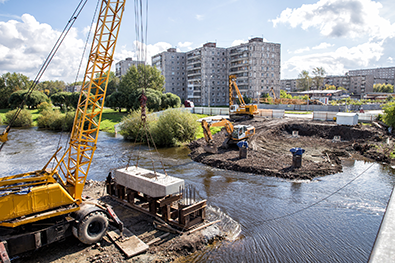
Today’s engineering market demands more than the traditional environmental, health, and safety (EHS) vendor can support. That’s why Triumvirate Environmental, an experienced environmental remediation company, provides a combination of deep industry knowledge and experience—enabled by the close collaboration of our field service specialists and consultants. We offer complete environmental remediation support services that create safe spaces and sites for workers, organizations, and the public.
Our highly trained and experienced teams can go on-site, check for contamination, manage cleanup projects, dispose of regulated and non-hazardous waste, deploy construction perimeter air-monitoring solutions, create safety training programs, and more. Through close personal relationships with client teams, they provide precise, data-driven environmental remediation services and savvy to customize site-specific plans. We also offer emergency remediation services to address unexpected contamination and urgent site conditions.
Our team members ensure engineering and remediation projects stay on time and on budget. This enables clients to meet financial and project goals—and enjoy optimum results. It also gives client managers peace of mind about meeting their commitments to their end customers.
Continuum of Engineering and Consulting Support Services
Our customers in the remediation, engineering, and construction industries have unique demands. Their projects often involve exceptional and complex challenges. Any given site may require multiple skill sets, technologies, systems, processes, and benchmarks. They can also involve the creation of compliant guidance documents, standard operations, and specific site plans.
Few, if any, remediation companies can supply the full continuum of environmental support services for your ever-changing needs. But our experts can offer and manage all these services, under one contract.
Waste Disposal
Remediation and construction projects come with specific waste disposal concerns. Our team members address these challenges safely and compliantly, as they specialize in:
- Investigation-derived waste (IDW) drum disposal
- Waste classification/field screening
- Groundwater containment and disposal
- Bulk soil disposal, including Resource Conservation and Recovery Act (RCRA)-regulated soil, Toxic Substances Control Act (TSCA)-regulated soil, and non-hazardous soil
Perimeter Air Monitoring
To successfully execute remediation projects in compliance with state and federal requirements, we provide the Greenlight™ System. It comprises a proprietary real-time perimeter air monitoring system with computer-based system controls. It offers:
- Rich data-sharing capabilities
- Wireless telemetry to relay real-time air monitoring data to the cloud
- A real-time user interface
- Alarm calculations and notifications
- Summary reports
Health and Safety Officer Oversight
Triumvirate Environmental is a proven partner that deploys the best health and safety representatives for construction and remediation sites. Our on-site health and safety officers provide:
- Industrial hygiene-oriented oversight
- Support for environmental remediation and high-risk sites
- Daily routine health and safety support
Field Services
Our team can provide an array of on-site services during your project timeline, including:
EHS Professional Services
Any gaps in capabilities can impact worker and public safety, and ultimately, the quality of the final project. Project completion can require audits, official reviews, and hazard assessments. To support these needs, Triumvirate Environmental can provide:
- Thorough audits
- Clear, concise, and accurate EHS procedures and written programs addressing topics such as confined spaces, respiratory protection, and personal protective equipment (PPE)
- Top-level EHS management
The successful implementation of EHS programs also demands the development and delivery of quality training. To that end, we offer:
- Extensive training programs on a variety of topics, including confined spaces, respiratory protection, Hazardous Waste and Emergency Response (HAZWOPER), and PPE
- Support for management/supervisory and operations staff
- Informative, timely, and high-quality courses
PFAS
Got PFAS? The EPA regularly updates its PFAS lists which span almost 200 compounds. Triumvirate Environmental provides testing and remediation services to help you manage them best—from testing to disposal, reporting and beyond.
Comprehensive Support for Your Next Project
Triumvirate Environmental understands the complexities of engineering and remediation projects. That's why our teams provide all the necessary environmental remediation services to keep your project on track and in compliance. Please fill out the form below to talk to our team.