

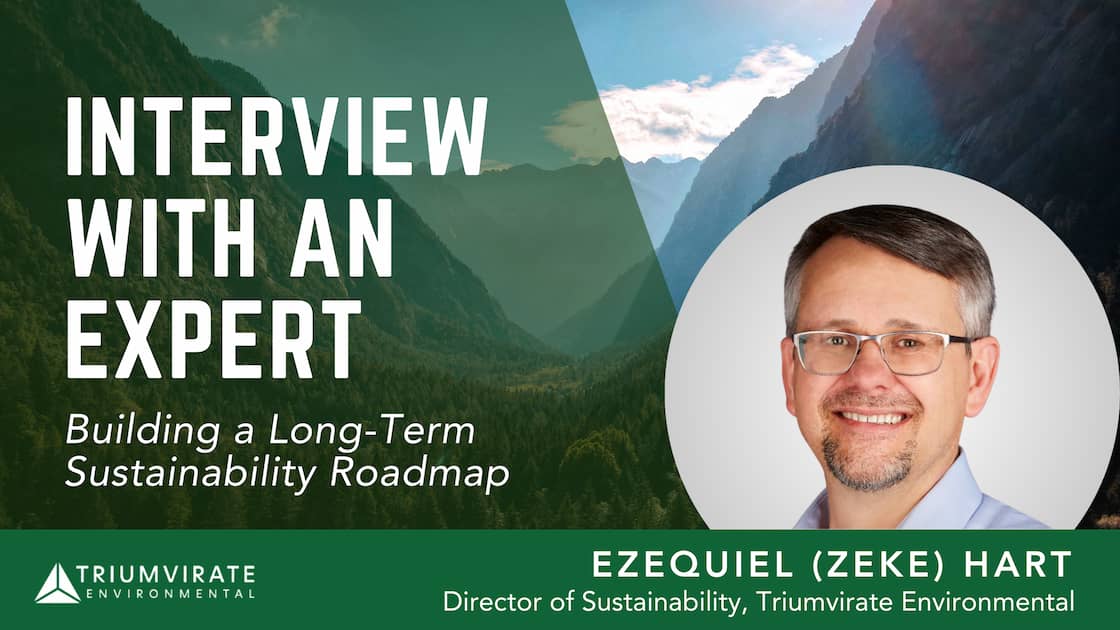
Building a Long-Term Sustainability Roadmap
As EHS and sustainability expectations continue to evolve across the environmental services and life sciences industries, companies are navigating a complex mix of regulatory pressure, customer demand, and economic uncertainty.
To better understand what lies ahead, we sat down with Ezequiel (Zeke) Hart, Triumvirate Environmental’s Director of Sustainability, to discuss long-term sustainability and how Triumvirate Environmental is positioning itself.
Q: How is sustainability changing for environmental services companies right now?
A: We’re in a period of transition, and it’s a more complex one than even a few years ago. In the United States, sustainability and ESG conversations are evolving amid shifting federal incentives and growing political polarization. At the same time, many organizations, especially those operating globally, are maintaining strong short and long-term sustainability commitments, particularly around climate action, resilience, and risk management, and there are greater expectations for clear governance, defensible data, and transparent reporting. Regulatory requirements are changing and fragmenting across jurisdictions, which adds another layer of complexity for companies operating at scale.
For companies like Triumvirate Environmental and our clients, that means staying focused on our sustainability commitments and priorities while simultaneously navigating a changing external landscape. Sustainability remains as essential as ever for supporting our customers, engaging our employees, and building resilient operations. To succeed, we will need to combine rigorous data and reporting with practical, operational initiatives that deliver real value.
Q: What does that mean for Triumvirate Environmental specifically?
A: Sustainability has always been a key part of how Triumvirate Environmental approaches environmental services. Over the past year, we’ve strengthened and honed that approach, building internal structure, strategy, and systems that allow us to plan more intentionally for the future—when we better ourselves, we’re able to better our customers as well.
This has been a foundational period. In addition to chasing short-term wins, like joining the Ceres Electric Vehicle Alliance (CEVA) and installing an EV charger in our Somerville warehouse, we’ve been investing in reinforcing the groundwork: defining corporate climate goals, improving data capabilities, and aligning our sustainability approach across the organization, so that we’re well positioned to make meaningful progress over the next decade.
Q: Where do you see the biggest sustainability priorities emerging over the next few years?
A: Climate will continue to be a central focus, but the conversation is expanding beyond emission targets alone. Regardless of economic or political cycles, climate-related risks are increasingly operational in nature. Extreme weather, supply-chain disruptions, and facility resilience are already affecting how companies plan, invest, and operate, including in regulated or logistics-intensive industries like ours.
Another key priority for sustainability professionals is better understanding how sustainability and compliance intersect. For many organizations, this is also a business opportunity. Customers increasingly expect their environmental service partners to help them not only stay compliant, but also meet—and in some cases exceed—their own sustainability goals in practical, operationally grounded ways.
Q: How does data factor into the future of sustainability at Triumvirate Environmental?
A: Data is essential for credible, long-term sustainability progress. You need a clear understanding of where you are today to plan where you’re going—especially in an environment where expectations around transparency and reporting continue to rise.
A major focus of this foundational phase has been improving how we gather, manage, and report environmental data. Companies are moving away from static reports and toward systems that support consistent sustainability metrics, audit-ready information, and a clear story of environmental progress; this, in turn, supports better decision-making across the organization. These capabilities are becoming critical not just for reporting, but for identifying where investments can deliver the greatest environmental and operational impact—and for satisfying environmental expectations of customers and stakeholders alike.
Triumvirate Environmental is paying close attention to how advanced analytics and AI can support sustainability work—whether through improved forecasting, scenario planning, or managing increasingly complex data requirements. As expectations continue to evolve, having strong data systems in place allows organizations to respond with confidence rather than on their gut reaction.
Q: What should customers be thinking about as sustainability expectations continue to evolve?
A: Even as the regulatory landscape changes and no matter what the long-term outcome, sustainability remains relevant for managing risk and building resilience. Climate and other environmental challenges aren’t going away, and companies that take a longer-term view are often better positioned to adapt.
We’re also seeing growing interest in more innovative sustainable solutions for waste management, including lower-carbon solutions and more circular approaches. These strategies take time to implement but will deliver meaningful value over the long run.
Q: What is a focus for Triumvirate Environmental in the year ahead?
A: We’re in the process of developing and beginning to implement a clear, actionable roadmap for sustainability that aligns with our business priorities and builds on our long-standing commitment to environmental excellence, in our work with clients and internally. We’re particularly focused on climate and sustainable waste management. On climate, we’ve committed to setting ambitious, science-based greenhouse gas reduction targets. Achieving these targets will require changes across our facilities, our fleet, and the methods we use to treat our clients’ waste. On the latter, we want to continue to expand how we help our clients find more sustainable options for waste disposal, including recycling, composting, and other beneficial reuse.
While sustainability is an ongoing journey, the next two to three years are especially important as we accelerate our efforts, building on the foundation we’ve set—reinforcing it and pushing full-steam-ahead. Our successes in the next few years will set the stage for continued long-term success.
Sustainability is also important from a talent perspective. We hire many early-career professionals with environmental and scientific backgrounds, and having a clear, credible sustainability roadmap matters to them. It reinforces that their work aligns with their values and that Triumvirate Environmental is committed to environmental leadership over the long term.
Q: Anything else you’d like to note?
A: The work happening now is about building upon our strong foundation for environmental sustainability leadership. By continuing to invest in alignment today, Triumvirate Environmental is positioning itself to make steady, meaningful progress over the next decade—supporting customers, engaging employees, and driving environmental improvements along the way.
We appreciate Zeke Hart taking the time to share his perspective on the future of sustainability at Triumvirate Environmental. Interested in learning more about how sustainability planning supports long-term environmental and business outcomes? Contact us today or learn more about EHSGreen™.