

Year after year, organizations across industries and throughout the nation fail to meet federal worker safety guidelines. And year after year, this oversight exposes laborers to needless injury or even death, opening organizations up to immense risk.
The proof of these conditions comes directly from the Occupational Safety and Health Administration (OSHA). The top 10 OSHA violations list outlines the most common standard violations—and year after year, this list of frequently cited OSHA standards contains the same repeat offenders, the top 10 most wanted criminals of the compliance world.
With frightening regularity, these “usual suspects” make the list of the top 10 OSHA violations—and generally, only their rankings change every year. Their recurring appearance on the list highlights both persistent noncompliance and OSHA’s vigilance in identifying violations.
Key Takeaways:
- OSHA violations occur when an organization breaks one of OSHA’s set safety guidelines. Violations can mean broader safety issues and usually come with a large fine.
- The same 10 OSHA safety standards continually rank as the most frequently cited.
- The only difference between last year’s OSHA top ten violations list and this year’s OSHA top ten violations list is the order in which these usual suspects occurred.
- The number of violations for all standards on the top 10 OSHA violations list has decreased since 2025.
- What is the most common OSHA violation? "Fall Protection – General Requirements" is consistently the most common OSHA violation.
- Facility and operations managers can better protect employees—and avoid associated violation costs—by focusing environmental, health, and safety (EHS) programs toward these specific standards.
| Standard | FY2024 Number | FY2024 Rank | FY2025 Number | FY2025 Rank | FY2026 Number | FY2026 Rank |
| 1926.501 - Fall Protection - General Requirements | 6,307 | 1 | 5,914 | 1 | 4,041 | 1 |
| 1910.1200 - Hazard Communication | 2,888 | 2 | 2,546 | 2 | 1,961 | 2 |
| 1910.147 - Lockout/Tagout | 2,573 | 3 | 2,177 | 4 | 1,863 | 3 |
| 1926.451 - Scaffolding | 2,443 | 5 | 1,905 | 7 | 1,725 | 4 |
| 1926.1053 - Ladders | 2,470 | 4 | 2,405 | 3 | 1,659 | 5 |
| 1910.134 - Respiratory Protection | 2,050 | 7 | 1,953 | 5 | 1,608 | 6 |
| 1910.178 - Powered Industrial Trucks | 1,873 | 8 | 1,826 | 8 | 1,379 | 7 |
| 1926.503 - Fall Protection - Training Requirements | 2,248 | 6 | 1,907 | 6 | 1,273 | 8 |
| 1926.102 - Personal Protective and Lifesaving Equipment - Eye and Face Protection | 1,814 | 9 | 1,665 | 9 | 1,120 | 9 |
| 1910.212 - Machine Guarding | 1,541 | 10 | 1,239 | 10 | 1,072 | 10 |
What Is the Occupational Safety and Health Administration (OSHA)?
Established in 1971, OSHA is a part of the US Department of Labor (DOL). They operate to ensure workers’ safety and health through adequate working conditions. Responsibilities include setting and enforcing safety standards, providing training and assistance to those they regulate, and more.
What Are OSHA Violations?
OSHA sets the standard for safe workplace practices—and enforces their implementation on worksites. Besides a hit to the bottom line, an accident caused by unsafe operations can also severely damage an organization’s reputation, and employees and patrons alike will lose trust that the company has their well-being in mind. OSHA’s annual “top 10 list” ranks the safety standards most frequently cited during workplace inspections.
OSHA Violations vs. Citations
An OSHA violation is the act of breaking the rule or going against the guidelines. An OSHA citation, on the other hand, is the formal notice (sent from the administration) stating that the violation has occurred; this is normally accompanied by a fine. Every year, the top 10 OSHA violations are compiled into a list.
What Does OSHA Look For Most?
OSHA is always looking for situations that cause “imminent danger.” These are situations wherein danger is obviously present and can cause serious physical harm or immediate death to workers. The most common OSHA violations are those that threaten imminent danger.
How Does OSHA Enforce Its Standards?
OSHA inspections regularly happen unannounced. The auditors thoroughly review all aspects of operations—and they may show up unannounced regardless of compliance or non-compliance in the past. When violations are found, citations are issued. From there, corrective actions or financial penalties may follow—which may even lead to shutdown if not properly addressed.
OSHA Violations Reporting
It may seem odd that the results for 2026 are available before the year has even ended—but this is because OSHA reports on a Fiscal Year which runs from October 1 to September 30. FY2026 results, for example, are pulled from October 1, 2025 through August 31, 2026.
Top 10 OSHA Violations
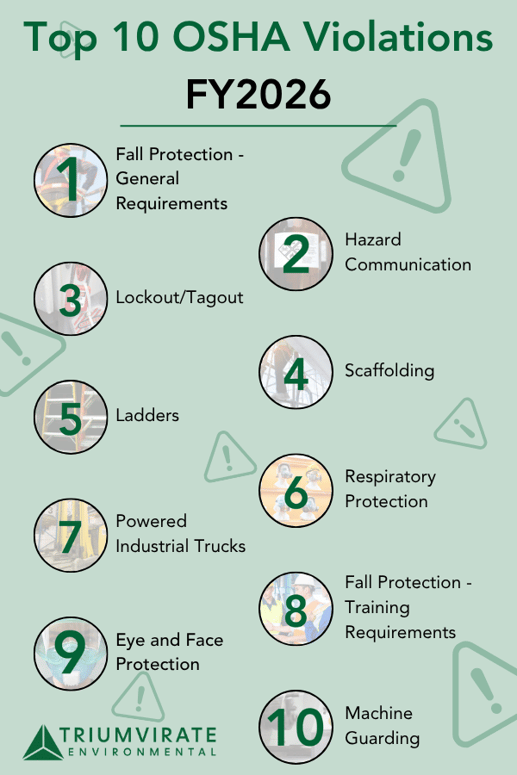
So, what are 10 of the most violated OSHA standards for 2026? Preliminary results show that they are:
1926.501- Fall Protection - General Requirements
| FY2026 Ranking | FY2026 Citations | FY2025 Ranking | FY2026 Citations |
| 1 | 4,041 | 1 | 5,914 |
OSHA’s 1926.501 - Fall Protection – General Requirements standard sets forth regulations for when workers are working at height or beneath equipment that may fall on them. It covers fall arrest systems, fall protection training, fall protection, and more.
The “Fall Protection – General Requirements” safety standard once again tops the list of OSHA’s top 10 most frequently cited standards—but fewer violations in 2026 than in 2025, 2024, and 2023 could show a repeating pattern of increased safety in this area. For more information about fall protection safety, see our "Fall Protection Safety: Strengthen Your Weak Spot" blog post.
1910.1200 - Hazard Communication
| FY2026 Ranking | FY2026 Citations | FY2025 Ranking | FY2026 Citations |
| 2 | 1,961 | 2 | 2,546 |
OSHA’s 1910.1200 - Hazard Communication safety standard regulates how physical and health hazards are communicated with workers in order to keep them safe. There are many methods of doing this effectively, as outlined by OSHA. Chemical inventory management, for example, can help ensure that chemicals are properly identified and labelled to avoid accidents or mishandling.
Like in prior years, the Hazard Communication OSHA safety standard appears high on the top cited standards list. Similarly to “Fall Protection – General Requirements,” there is a downward trend in violations that could be indicative of a shift toward hazard communication safety prioritization. To learn more about the requirements of this standard, see our blog about hazard communication.
1910.147 - Lockout/Tagout
| FY2026 Ranking | FY2026 Citations | FY2025 Ranking | FY2026 Citations |
| 3 | 1,863 | 4 | 2,177 |
Lockout/tagout is how workers implement redundancy controls to prevent injuries from hazardous energy. It is especially critical around large, highly energetic equipment that requires maintenance.
OSHA’s 1910.147 - Lockout/Tagout standard moved up one spot since 2025 and two spots since 2024, ranking third on OSHA’s top 10 most violated standards list for 2026. Overall, though, citation amounts are declining.
1926.451 - Scaffolding
| FY2026 Ranking | FY2026 Citations | FY2025 Ranking | FY2026 Citations |
| 4 | 1,725 | 7 | 1,905 |
Scaffolds are common across construction and industrial sites. Used correctly, they are powerful and useful in these operations. Without following OSHA safety regulations, however, employees risk falls, falling objects, collapse, and more.
OSHA’s 1926.451 - Scaffolding standard jumped from seventh on OSHA’s top cited standards list for 2025, but violations are decreasing overall; this could mean that scaffolding set-ups are getting safer but are more heavily scrutinized.
1926.1053 - Ladders
| FY2026 Ranking | FY2026 Citations | FY2025 Ranking | FY2026 Citations |
| 5 | 1,659 | 3 | 2,405 |
Ladders are a necessary tool, but come with risks that are mitigated by strict adherence to OSHA standards. The qualities of a ladder and the environmental factors surrounding it—ladder rung spacing, construction procedures, weight limits, fall arrest systems, and placement—are all standardized to optimize workers’ safety.
The 1926.1053 - Ladders OSHA safety standard has moved down to fifth on the top 10 OSHA violations list and displays a downward trend in violations. One potential conclusion is that ladder use continues to get safer with compliance.
1910.134 - Respiratory Protection
| FY2026 Ranking | FY2026 Citations | FY2025 Ranking | FY2026 Citations |
| 6 | 1,608 | 5 | 1,953 |
Airborne hazards in the workplace risk employee health and research or product integrity. With flu season on the horizon and COVID-19 a not-so-distant memory, protecting workers’ respiratory health is paramount. This OSHA safety standard covers masks, respirators, fit testing, maintenance and cleaning, and training within a workplace’s Respiratory Protection Program (RPP). A thorough industrial hygiene program will help ensure any RPP or relevant respiratory personal protective equipment (PPE) is up to snuff.
Moving down from fifth on OSHA’s top 10 most commonly cited standards for 2025, the 1910.134 - Respiratory Protection OSHA safety standard was sixth most violated in 2026. A decrease in overall violations suggests continued improvement in workplace safety practices.
1910.178 - Powered Industrial Trucks
| FY2026 Ranking | FY2026 Citations | FY2025 Ranking | FY2026 Citations |
| 7 | 1,379 | 8 | 1,826 |
Powered industrial trucks have myriad uses on a worksite; from moving heavy loads to getting around faster to lifting things, these tools are essential. Failure to follow OSHA safety guidelines, however, can lead to tip-overs, falling loads, collisions, or fires that cause serious injuries or fatalities. OSHA attempts to regulate all aspects of powered industrial trucks on a worksite.
Overall, the use of powered industrial trucks is potentially safer in 2026 than in 2025 or 2024; even though the OSHA 1910.178 - Powered Industrial Trucks safety standard moved up a ranking from eighth in 2025, the number of violations is starting to decrease.
1926.503 - Fall Protection - Training Requirements
| FY2026 Ranking | FY2026 Citations | FY2025 Ranking | FY2026 Citations |
| 8 | 1,273 | 6 | 1,907 |
Fall protection is such a hot topic that it appears twice on the top 10 OSHA violations list. Unlike the number one violator, eighth on 2026’s top 10 violations list deals with fall protection training—how to minimize hazards, how to inspect equipment, and limitations of fall protection. EHS training specific to fall protection helps with meeting compliance needs.
More robust OSHA fall protection training regulations are working, as evidenced by the 1926.503 – Fall Protection – Training Requirements OSHA safety standard moving from sixth to eighth on OSHA’s most cited standards from 2025 to 2026. The number of violations is also decreasing, indicating possible better fall protection training overall. For more on fall protection training safety, please read our fall protection training blog post.
1926.102 - Personal Protective and Lifesaving Equipment - Eye and Face Protection
| FY2026 Ranking | FY2026 Citations | FY2025 Ranking | FY2026 Citations |
| 9 | 1,120 | 9 | 1,665 |
This OSHA safety standard includes the tools used to protect workers’ eyes and faces from flying objects, molten metals, corrosives and chemical vapors, dust, and more—goggles, safety glasses, hard hats, etc. Again, this is where a thorough industrial hygiene program can work wonders for safety and compliance.
1926.102 - Personal Protective and Lifesaving Equipment – Eye and Face Protection OSHA safety standard occupied the nineth spot in 2024, 2025, and 2026 on OSHA’s top 10 most frequently cited standards lists. Overall, fewer violations could indicate safer practices with regard to protective and lifesaving equipment in the workplace.
1910.212 - Machine Guarding
| FY2026 Ranking | FY2026 Citations | FY2025 Ranking | FY2026 Citations |
| 10 | 1,072 | 10 | 1,239 |
OSHA’s 1910.212 - Machine Guarding standard regulates moving machines—millers, revolving barrels, conveyor belts, robotic arms, shears, power presses, and more. The rules exist to prevent trapping workers, causing slicing or stabbing injuries, crushing, strikes, and more via devices and guards to physically prevent risk.
Machine Guarding remained in tenth place in 2024, 2025, and 2026 on OSHA’s list of top 10 most commonly cited. As with the rest of the standards on this list, overall fewer violations could indicate safer practices.
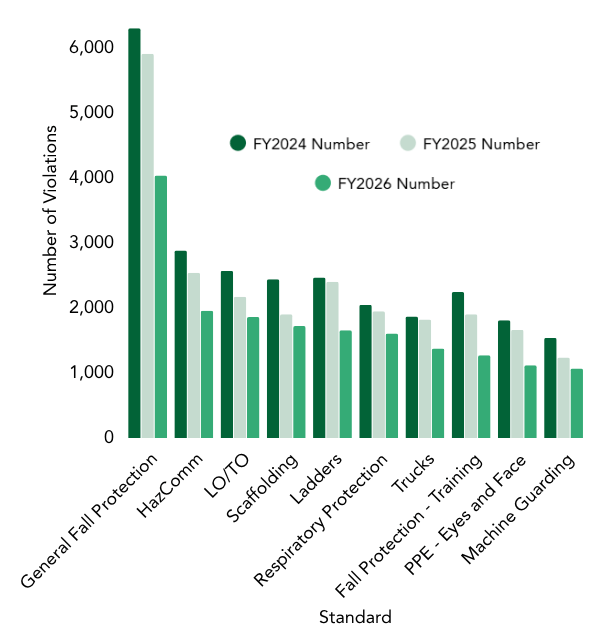
Note that the number of violations from all of the top cited OSHA standards have decreased overall. This underscores the connection between safety and compliance; and speaks not only to the importance of regulation, but to the necessity of audits and safety reviews before auditors come knocking.
Partnering for OSHA Compliance Support
Clearly, there is a need to continue advocating for safe, compliant workplaces—as evidenced by the usual suspects showing up on 2026’s top 10 OSHA violations list. For help ensuring safety and compliance this year and into the future, contact Triumvirate Environmental. We can help you achieve compliance and avoid getting cited for the violations that grace the top 10 OSHA violations list. Let us help you with some preventative measures like:
- Chemical inventory management to streamline hazard communication
- EHS audit services to review onsite programs
- Industrial hygiene for PPE and airflow assessments
- Extensive EHS training
- Onsite environmental services to take risk off your team
- EHS consulting for all the rest
The “usual suspects” don’t have to become recurring problems at your facility. Use OSHA’s top 10 violations as a starting point to review your safety programs, identify training gaps, and prioritize corrective actions—not as a substitute for a comprehensive compliance review.
Ready to take the next step? Contact Triumvirate Environmental to discuss an EHS audit to identify practical ways to strengthen compliance, protect employees, and reduce operational risk.
OSHA Compliance FAQ