

Understanding the Bigger Picture with EHS
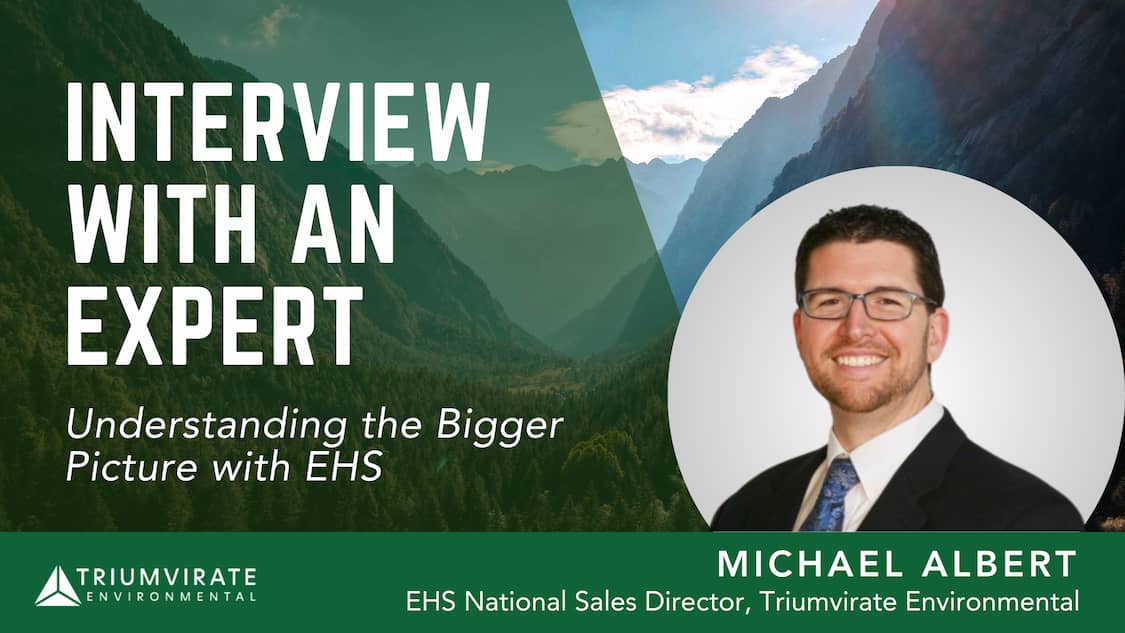
Environmental, Health, and Safety (EHS) programs are becoming more complex as organizations balance regulatory requirements, operational efficiency, and risk management. We spoke with Mike Albert, EHS National Sales Director at Triumvirate Environmental, about how his experience across waste operations, program management, and client support helps organizations navigate increasingly complex EHS challenges.
Q: Can you tell us a bit about your background and your role at Triumvirate Environmental?
A: When I first began at Triumvirate Environmental 18 years ago, I learned the business from the ground up–moving waste drums around, driving trucks, and performing other onsite tasks. As the company grew, my responsibilities expanded in this Environmental Specialist role as I started focusing on managing the entire regulated waste management programs and learning how this program fits into the overall EHS compliance program. From there, I’ve continued to scale to support our teams and clients solve larger, more complex challenges. Today, I’m in a technical sales support role, collaborating with our team to figure out the best options to support clients with highly complex EHS needs. While there’s always a waste component, there’s also a much broader health and safety perspective that clients see day in and day out around the Safety and Health of their company—and that’s becoming increasingly more relevant in today’s compliance and regulatory landscape.
Q: Are there any milestones or moments at Triumvirate from 2025 that you’re most proud of?
A: I’ve watched people across our teams—including the sales team, internal consulting, and operations management—take on new responsibilities, embrace new challenges, and create opportunities for the next step in their careers. Mentoring and coaching have been major internal goals at Triumvirate; I’ve benefited from having strong mentors myself, and I have a passion for mentoring others.
I’m also proud of how we’ve been able to scale and customize our support structure; we’ve seen this in full HD this past year, building upon our foundations set from the very beginning. It’s exciting to make all the EHS pieces fit together and enable full EHS compliance program management at organizations of all sizes. Great successes come from each unique challenge and solving these challenges with fellow team members and learning new regulatory rules that need to be utilized.
Q: As the EHS landscape becomes more complex, what do you think are the biggest forces shaping the industry?
Over the past year, we’ve seen federal funding shift in ways that directly affect pharmaceutical companies, manufacturing operations, and research institutions. Funding decisions from federal agencies can influence research, development timelines, and overall investment in life sciences. Research drives change and without this funding and push for new discoveries, it has been a ‘lull’ in overall movement forward in 2025.
At the same time, there are areas of intense focus, such as weight loss drugs, which are driving competition and shifting industry attention. Major FDA decisions can have cascading impacts across the sector. Take a look at the different medications, from pills to shots, these types of impacts on people can be lifechanging.
We’re also seeing significant growth and complexity in advanced manufacturing, particularly in the semiconductor industry, specifically in the United States build out of companies and infrastructure. It’s not just the major chip manufacturers that need support, the smaller companies in the supply chain that need EHS guidance—and quickly. This is in turn to more manufacturing in the US and the companies who are in need of higher volume of semiconductors within the US for product production that can deliver faster. Faster production, faster products are sold, and faster overall growth of several layers of these companies, who are the heart of product development and manufacturing.
Q: What does a more proactive approach to EHS look like?
A: Proactive EHS means thinking years down the road, continually minimizing risk, and positioning the organization for long-term success. That includes protecting employees, maintaining facilities and infrastructure, ensuring environmental sustainability, meeting regulatory requirements, and managing budgets effectively.
Being proactive also means earning a seat at the executive table. EHS leaders should be involved early in construction projects, growth initiatives, potential downsizes, and business strategy discussions. When an EHS professional is involved early, they can help shape outcomes; if they’re brought in too late, they’re left spending their time fixing preventable problems.
Think of a chess match. In chess, you need to think 3-6 moves ahead to think of strategies and critical situations of success and potential hazards. One wrong move, in the wrong order, could lead to a catastrophic loss, losing the king. However, with strategic thinking of multiple pieces, avoiding hazards (losing the least number of pieces as possible), and protecting your most important piece on the board, you can make choices to save your team and win!
I know it isn’t always about winning, but chess, similar to hazardous work environments, change constantly depending on inputs from the opponent. In real life, opponents are hazards in the workplace, unknown changes to the environment, and team members who might not be thinking 2-3 moves ahead but focused on the goal of what they are doing, to get it done quickly and efficiently. Speed isn’t the end all be all, nor is running a fully compliant EHS program. Hazards happen, it's how proactive we can be to allow the least number of hazards from occurring and, if they do, be ready on how to deal with it.
Q: How does Triumvirate help clients stay ahead of regulatory and operational complexity? Any specific examples of innovation?
A: Staying ahead starts with education–continuously learning, attending conferences, and engaging with experts who may have deeper or different perspectives. It also requires paying close attention to political and economic trends, because funding and investment patterns influence operational decisions.
From an operational standpoint, EHS teams must balance hands-on responsibilities with strategic thinking. If leaders remain focused only on day-to-day tasks, they miss opportunities to anticipate larger challenges. If they only focus on the larger challenges, day-to-day compliance, waste, and operational tasks may fall to the wayside.
We’re seeing significant changes in the energy sector, including advancements in battery technology and alternative energy production with fusion energy research. These developments have the potential to dramatically change energy infrastructure, and EHS professionals must understand and prepare for those shifts.
With every shift comes a new challenge and hazard yet to be explored. We can still try to be a chess grandmaster as an EHS professional; however, consistent research, review, and assessments are needed to continually pursue optimal compliance. Innovation will change how we operate, look for it to change positively and proactively into the future.
Q: Where do you see companies successfully turning EHS from a requirement to a strategic advantage?
A: Honestly, any company can be successful if, they think of it as part of their culture and a necessity for a long-term strategy for safety and environment, not a check box. Where I see this most often, though, is in medium-to-large life sciences organizations, particularly within R&D. These companies are using strategic partnerships not only to manage risk but also to strengthen their public image and improve operational efficiency. They recognize that environmental responsibility and safety are interconnected and that sustainable substitutions must also be evaluated from a safety perspective. Sustainable solutions can come from vendors who support the overall vision, growth avenues through similar work, or legitimate environmental solutions. In this way, they are taking safe and compliant EHS program management and combining it with sustainable strategic partnerships to result in a more holistic, strategic EHS position. It’s not just a box to check to get work done and stay safe, it’s a culture that continually evolves over time to limit risk, think sustainably, and keep liabilities lower.
Q: Triumvirate works with organizations of all sizes, from smaller labs to larger enterprises. How does the approach shift based on what stage of growth the company is at?
A: For smaller companies, budgets are limited and the focus is primarily on proving their science and securing funding; no product, no revenue, no business. In those cases, the support we provide is often targeted and focused on meeting essential requirements for compliance and will set a compliant baseline for future growth in EHS.
As companies grow into mid-sized organizations, liability increases and visibility expands. EHS becomes more critical, especially because safety incidents can quickly impact employees, reputation, and retention. More processes, more people, more options for success drive further expansion of EHS need and culture. This is also a key moment when moving into a larger space as a stand-alone company. It will be very important to set the tone in safety culture, and rationalize it is important to understand it enough to hire someone or have outside support.
For larger organizations, the product continues to remain the primary focus, but safety and environmental management are close behind. Strong EHS programs help retain employees, protect long-term health, and ensure sustainable operations. The difference in safety culture and facility conditions across large organizations can be dramatic, and EHS plays a major role in that outcome. Even starting from safety committee meetings and becoming a key partner in process development is a must for long-term success.
Q: What should leaders prioritize to stay ahead on environmental safety, sustainability, and governance (ESG)?
A: When leaders consistently seek a seat at the table and stay ahead of changes, their impact on safety and sustainability is far greater. Organizations of all types should involve EHS leadership early in planning processes, particularly during planning, construction, and expansion projects, to ensure ESG (and other EHS) considerations are in play from the very beginning. Waiting until a project is already underway can lead to costly and avoidable mistakes.
Q: Anything else you’d like to note?
A: Triumvirate has grown tremendously over the past 38 years, and I’ve been fortunate to be part of that journey. It’s been rewarding to watch the company grow, evolve, and add valuable support structures for our client partners.
I value the Triumvirate culture, which emphasizes partnership and collaboration—both within the company and with clients. One of my ongoing goals is to continue spreading that culture and helping us solve more complex problems as we move into the future. We’ve been a trusted EHS services firm for organizations of all types and sizes for almost four decades, and that vast experience is helping us stay ahead of the curve when it comes to long-term EHS success.
We appreciate Mike Albert taking the time to share his perspective on the future of EHS at Triumvirate Environmental. Interested in learning more about how EHS can minimize risks, enhance sustainability, and drive business efficiency? Contact us today or learn more about EHSOne®.