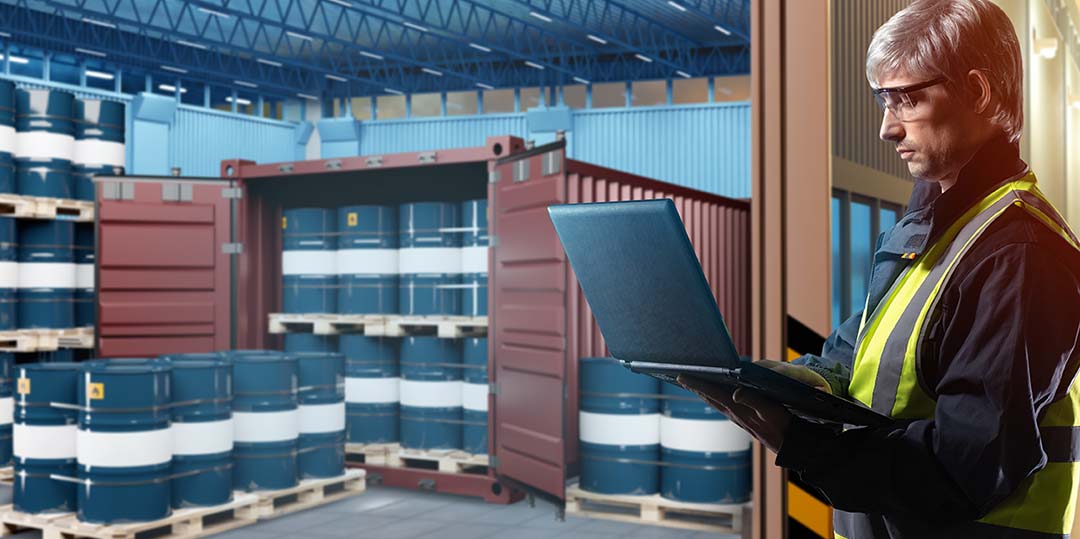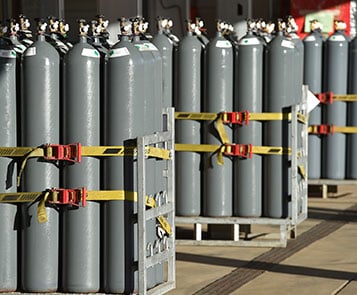




Warehouses and distribution centers today handle an ever-growing mix of products: regulated goods, defective goods, damaged materials, a nd more. A 3PL compliance gap analysis helps teams spot where EHS controls, waste handling, and documentation are starting to drift. This can be complex enough before considering returns logistics and customer-specific packaging requirements. And as operations scale, so do the number of touchpoints where Environmental, Health, and Safety (EHS) responsibilities emerge—often outside of any formal EHS program. In third party logistics operations, a 3PL compliance gap analysis can reveal the hidden places where responsibility falls between operations, safety, transportation, and waste management.
In third-party-logistics (3PL) environments, hazardous materials don’t arrive labeled as “waste.” They become waste through everyday operations—returns, damage, repackaging, and storage decisions made on the floor. These often-unpredictable circumstances create the perfect storm for compliance gaps.
And it’s not because teams don’t care, but because responsibility is fragmented across operations, safety, transportation, waste, and more. The result? Risk builds quietly, until it shows up as a failed audit or warehouse compliance gap analysis, a shipment rejection, or a regulatory violation. When it comes to assessing those risks, most people don’t know where to start with a 3PL compliance gap analysis.
This guide is designed to help you identify those gaps before they become incidents.
Why Conduct a 3PL Compliance Gap Analysis?
A focused 3PL compliance gap analysis helps supply chain teams understand where controls are working, where they are inconsistent, and where regulatory risk is building across the warehouse. It can also support a more practical warehouse compliance checklist, because the goal is not to score every detail perfectly—it is to identify the handful of process points that create the biggest exposure.
For many third party logistics teams, the exercise also clarifies ownership. When a warehouse compliance audit or customer review happens, everyone should know who owns waste determinations, storage controls, documentation, and escalation paths. That clarity helps reduce 3PL EHS compliance risk before it turns into a violation, a shipment hold, or a client issue.
Common 3PL EHS Compliance Challenges and Risks
Most supply chain organizations are structured around speed, throughput, and client service. In the grand scheme of things, regulatory task ownership is seen as pretty marginal compared to the other demands of the business. Compliance responsibilities are often distributed across operations, safety, transportation, waste, and client-specific SOPs. Add in constant change—new customers, new SKUs, new shipping requirements—and even well-run facilities can drift into risk without realizing it.
EHS Regulatory Requirements Oversight
Hazardous materials shipping, waste classification, and storage requirements are nuanced—and frequently updated by the multiple regulatory agencies that dictate and enforce the rules. This includes the Environmental Protection Agency (EPA), (Department of Transportation (DOT), Occupational Safety and Health Administration (OSHA), the Food and Drug Administration (FDA), and the Drug Enforcement Administration (DEA). Each has distinct, defined requirements that don’t always align cleanly at the operational level.
Third-Party Logistics Operations in a Vacuum
Frontline teams make real-time calls on damaged goods, returns, or relabeling without clear 3PL EHS compliance guardrails. If the regulatory experts within the organization have knowledge that needs to trickle down to the teams with boots on the ground, it’s up to managers and supervisors to enforce. Making organization-wide adjustments to workflows across disjointed teams can be difficult, especially when tasked to busy managers and supervisors. As a result, compliance requirements easily—and often—get lost in the shuffle.
Staffing, Training, and Skills
High turnover and/or inconsistent training leads to inconsistent handling practices across shifts or sites. That creates distribution center EHS compliance risks when people are making the same call differently from one dock, shift, or site to another. Distribution centers with volume volatility—either due to seasonal shifts or political influence—experience erratic inbound and outbound shifts. Warehouse floors can go from full staff to labor shortages and bottlenecks in short time. Having to rehire, retrain, or reskill employees can easily set the stage for distribution center compliance risk if not handled the right way.
Organizational Structure
When it comes to hazardous waste generated in 3PL operations, waste-related responsibilities are not owned by a single function. One team handles damaged goods. Another manages inventory write-offs. Operations moves materials. EHS oversees safety. Procurement manages vendors. Documentation may live in multiple systems—or nowhere consistent.
Organizational change can make these issues worse. New customer accounts, acquisitions, network expansion, leadership turnover, automation projects, and shifting responsibilities between corporate and site teams can all disrupt established processes. What worked for one facility, one customer, or one product mix may not work at scale or during times of transition.
Warehouse Hazardous Waste Handling
Another common challenge is knowing when a product officially becomes waste—and which wastes are hazardous to require special handling. In many 3PL compliance gap analysis reviews, this is one of the first places hidden risk shows up.
Not only that, but different hazardous waste streams require vastly different handling, transportation, and disposal techniques—if not properly trained, onsite teams may be earnestly trying to correctly dispose of waste, but unknowingly creating a compliance nightmare.
Returned, expired, recalled, damaged, leaking, off-spec, or unsellable goods often enter a gray area between inventory and disposal. Until there is a clear determination, materials may sit in temporary storage, move through the wrong process, or be handled inconsistently across sites.
See how this all adds up, and how hazardous waste generated in 3PL operations can drift into risk? For distribution centers, these risks may not even be immediately obvious, compounding and resulting in larger issues. Knowing where to find the hidden operational blind spots that develop is an important skill to have when business grows faster than the systems within it.
Where 3PL Compliance Gaps Occur in Warehouse Operations
Many warehouse compliance issues don’t begin with one-off incidents—they start inside everyday operational decisions. That is why a 3PL compliance gap analysis is often more useful than a one-time spot check. The faster the environment moves, the easier it is for small inconsistencies to become larger risks. For 3PLs, repeat exposure is common across different areas.
Returns and Reverse Logistics Compliance Risks in 3PL Warehouses
Reverse logistics is one of the most common pressure points in a 3PL operation. Returned goods may arrive opened, partially used, expired, temperature-exposed, damaged in transit, or missing original packaging. Some products can be re-entered into inventory; Others require rework, quarantine, recycling and reuse, or disposal.
Teams may rely on ad hoc judgment calls for managing these goods that vary by shift, site, or customer account.
Compliance gaps may arise when there is:
- No documented process for evaluating returned materials
- Unclear ownership between customer, warehouse, and EHS teams
- Delays in determining whether material is saleable inventory or waste
- Inconsistent handling of regulated returns such as chemicals, aerosols, batteries, or healthcare products
- Poor documentation of final disposition
Handling Damaged Goods and Hazardous Materials in Warehouses
A compromised package can quickly become both a safety and compliance event. If the response process is unclear, frontline employees may focus only on cleanup while overlooking segregation, regulated waste container compatibility, exposure controls, or reporting requirements.
Compliance gaps may arise when there is:
- No standardized spill or emergency preparedness and response plan
- Improper overpacking or temporary containment
- Missing PPE or response materials
- Failure to document recurring damage trends
- An unclear escalation process for unknown substances
- Inadequate training for warehouse associates handling first response
- Lack of protocol for commercial hazardous waste disposal
Special consideration needs to be taken for recurring leaks or product damage. If the root cause is never addressed, risks also recur and may compound.
Repackaging and Relabeling Compliance Requirements
Value-add warehouse services such as relabeling, kitting, reboxing, and repackaging can generate secondary waste streams that are often underestimated. Contaminated packaging, absorbents, discarded labels, off-spec product, partially used containers, and damaged components all require proper, safe handling and disposal. As service offerings expand, waste complexity expands—as do gaps.
Compliance gaps may arise when:
- All new waste streams are not added to site procedures
- Packaging waste is mixed with regulated material
- Labeling errors impact downstream handling
- No process exists for partially used or residual product
- Rework stations operate outside established waste controls
Temporary Storage Decisions and Hazardous Waste Accumulation Risks
Temporary storage areas are often created for practical reasons: peak volume, customer holds, pending decisions, or limited dock space. In many distribution center compliance risks reviews, this is where material quietly crosses from temporary staging into unmanaged accumulation. Over time, however, these “short-term” solutions can become unmanaged accumulation points; materials without clear ownership tend to stay longer than intended.
Compliance gaps may arise when:
- Time limit and review cadence is missing for staged materials
- Containers are stored without labels or dates
- Incompatible materials are stored together
- Storage overflows into aisles or non-designated areas
- Satellite storage zones are not inspected
- There is no trigger for escalation once volume thresholds are reached
For many third-party logistics organizations, operational processes evolve faster than the controls designed to support them.


Warehouse Compliance Gap Analysis: A Quiz
Not every warehouse or distribution center starts at the same place. Some operations react to issues as they arise, whereas others have built repeatable systems that scale across customers and sites. We developed a quick 3PL compliance assessment so that you can determine how at-risk your operations might be.
Use the categories below to evaluate whether your current operation is buil t to scale—or vulnerable to (preventable) risk.
Waste Classification and Generator Status
Do you understand what waste is being generated, how it should be classified, and what obligations may apply to your site? As customer inventories change, new SKUs are introduced, and damaged or unsellable goods move through the warehouse, waste obligations can change quickly. This category evaluates whether your operation can accurately identify waste streams, assign ownership, and keep pace with changing generator requirements.
Give yourself a point for each of these boxes you check off.
Our operations have:
☐ A clear process for identifying new waste streams
☐ Current waste profiles and characterization records
☐ Defined ownership for waste determinations
☐ Regular review of generator status and volume changes
☐ An escalation path for unknown or unusual materials
☐ Site teams that know when to involve specialists
TOTAL: _____ (Add up how many you checked off and move to the next category.)
Hazardous Waste Handling and Storage
Once a product becomes waste, day-to-day handling matters. Storage practices, labeling, inspections, and employee consistency all influence safety, compliance, and operational efficiency—especially in fast-moving warehouse environments. Are materials being stored safely, consistently, and in a way that supports smooth operations?
Give yourself a point for each of these boxes you check off.
Our operations have:
☐ Clearly marked accumulation and storage areas
☐ Standard labeling and container management practices
☐ Inspection schedules with documented follow-up
☐ Trained staff across all shifts
☐ Segregation controls for incompatible materials
☐ Overflow plans during seasonal or volume spikes
TOTAL: _____ (Add up how many you checked off and move to the next category.)
Chain of Custody and Compliance Documentation
Customers and regulators may both expect proof of what happened to materials after they left inventory. This category measures traceability, documentation control, reporting readiness, and your ability to verify final disposition.
Can you confidently show what happened to materials from generation through final disposition (including, as relevant, disposal)?
Give yourself a point for each of these boxes you check off.
Our operations have:
☐ Complete shipping and disposal records
☐ Easy access to manifests, certificates, and service data
☐ Consistent documentation of internal transfers
☐ Customer reporting available
☐ Centralized records with version control
☐ Fast response to audit or client inquiries
TOTAL: _____ (Add up how many you checked off and move to the next category.)
Waste Disposal Vendors and Compliance Practices
Your compliance program is only as strong as the partners supporting it. This category looks at vendor oversight, service reliability, contingency planning, and whether disposal decisions are proactive or reactive. Are your downstream partners helping reduce risk—or introducing more of it?
Give yourself a point for each of these boxes you check off.
Our operations have:
☐ An approved vendor aligned with waste streams, disposal options, and service needs
☐ Clear expectations for responsiveness and documentation
☐ Backup options for capacity or emergencies
☐ Visibility or manifest documenting what happens when waste leaves the site
☐ Consistent pricing and scope visibility
☐ Strategic planning for changing needs
TOTAL: _____ (Add up how many you checked off and move to the next category.)

Compliance Risk Score
Ready to see how your organization scores? Add up your points from each of the four categories to find out your compliance risk score.
0–8: Reactive
Your operation may rely on informal workarounds, inconsistent execution, or limited visibility. As a result, gaps or issues are often addressed only after they cause disruption.
9-18: Standardizing
You likely have some good processes in place, but they may not yet be consistent, scalable, or fully documented across teams, shifts, or sites.
19-24: Audit-Ready
Your program is more structured, proactive,  and resilient. You likely have stronger controls in place to withstand growth, customer scrutiny, and regulatory review.

How to Fix 3PL Compliance Gaps in Warehouse Operations
Finding gaps is not a failure—it’s the point of the exercise! You can’t fix what you don’t know about.
Most 3PL operations are balancing customer demands, labor pressures, throughput goals, changing inventories, and evolving compliance expectations at the same time. Even strong teams can outgrow processes that once worked well. What matters most is how you respond once improvement areas are visible.
Standardize Core Processes
If critical tasks are handled differently by shift, supervisor, site, or customer account, risk increases quickly.
Start by documenting the workflows that matter most, such as:
- Returns triage and waste determination
- Damaged or leaking material response
- Labeling and container management
- Temporary storage controls
- Shipment documentation and record retention
- Vendor escalation and service issue response
The goal is repeatability. Clear processes reduce decision fatigue, improve training, and create more consistent outcomes across the operation—all while reducing distribution center compliance risks.
Align Across Sites
For multi-site 3PL networks, one of the biggest hidden risks is inconsistency between sites.
A process that works well at one facility may be unknown at another. One customer may receive strong reporting while another receives none. One site may have excellent storage controls while another relies on workarounds.
Start by identifying which standards should be enterprise-wide and which can remain site-specific. Many organizations benefit from a common baseline for:
- Waste handling expectations
- Documentation standards
- Vendor governance
- Training requirements
- Distribution center EHS audit readiness
- Escalation paths
Local flexibility still matters, but core expectations should not depend on geography.
Bring in External Validation
Internal teams are often closest to the work, which can make it harder to spot process blind spots, legacy workarounds, or improvement opportunities that have become normalized over time.
A third-party warehouse compliance audit can help validate what is working, uncover hidden risks, benchmark maturity, and prioritize the changes that will have the greatest operational impact. It can also sharpen the warehouse compliance checklist your team uses internally so the same issues do not keep resurfacing.
Sometimes the fastest path forward is an outside perspective.
3PL Compliance Assessment and EHS Support Services
Triumvirate Environmental helps complex operations build safer, more scalable, and more resilient EHS programs and waste disposal programs. For many teams, that starts with a 3PL compliance gap analysis and a clear plan to close the biggest warehouse compliance checklist items first.
For 3PLs, support can range from a focused site assessment to fully embedded onsite services, depending on your operation, customer mix, and industry requirements.
Embedded EHS Support That Fits Your Environment
No two warehouses operate the same way. A life sciences distribution center may need integrated waste management and support for regulated materials, expired inventory, and audit-ready documentation. A healthcare logistics operation may require programs for medical waste, recalls, or chain-of-custody controls. An industrial or manufacturing-focused site may need help managing aerosols, batteries, chemicals, universal waste, or high-volume damaged goods.
This should include services from one dedicated EHS partner for:
- Embedded EHS support services
- Waste stream identification and profiling
- Returns and reverse logistics process design
- Non-hazardous and commercial hazardous waste disposal management
- Dangerous goods and materials handling guidance
- Storage area optimization and inspections
- EHS Training for warehouse and operations teams
- Vendor management and disposal strategy
- EHS consulting for distribution centers
- Documentation and reporting improvements
- Multi-site standardization initiatives
- Compliance planning and ongoing program support
Whether you need added expertise at one location or a more unified strategy across a national network, support should be tailored to your specific business.
Ready to Strengthen Your Waste Disposal or Compliance Program?
If this warehouse compliance gap analysis uncovered inconsistencies, hidden risks, or areas that may not scale with growth, now is the time to act.
Request a site-level 3PL compliance gap analysis or status check today and identify practical opportunities to strengthen your operation
Frequently Asked Questions