



The National Institutes of Health (NIH) is moving toward a broader, risk-based biosafety framework that could affect research governance, documentation, training, incident reporting, and laboratory operations across NIH-funded institutions. The draft expands biosafety oversight from a relatively narrow focus on recombinant or synthetic nucleic acid research to a much broader range of biological hazards.
Organizations should begin evaluating how expanded biosafety oversight may affect their programs and resource needs. Under the current NIH Guidelines, Institutional Biosafety Committees (IBCs) are largely associated with oversight of recombinant or synthetic nucleic acid research. The draft policy broadens the scope of biosafety oversight, which would likely increase the IBC’s responsibilities.
What Is the Draft NIH Biosafety Policy for Research Involving Biohazards?
The Draft NIH Biosafety Policy for Research Involving Biohazards is part of the NIH Biosafety Modernization Initiative, an effort to replace portions of the existing NIH Guidelines framework and keep pace with the rate of science and technology innovation.
When finalized, the new policy would supersede—not merely amend portions of—the current NIH Guidelines for Research Involving Recombinant or Synthetic Nucleic Acid Molecules.
NIH released the draft for public comment on August 19, 2026. Because the framework is still a proposal, individual provisions may change before NIH issues a final policy. Even so, the draft gives research institutions a clear view of NIH’s intended direction: broader coverage, more risk-calibrated review, stronger institutional accountability, and more public documentation.
Key Changes from the Current NIH Guidelines
Institutions across life sciences, biotech, academic medical centers, research hospitals, and universities could see four things change at once—the scope of formal oversight, the documentation needed to demonstrate compliance, the review pathway for different levels of risk, and the resources required to keep research moving. For research organizations, the NIH biosafety modernization initiative is most likely to show up in these four practical areas:
Expanded Scope of Biosafety Oversight
NIH is proposing broader requirements and enhanced responsibilities for IBCs. NIH-funded organizations may need to evaluate a wider range of research activities under formal biosafety governance.
The draft defines covered research as “all biomedical research, in laboratory settings, involving biohazards. For the purpose of the scope of this Policy, research involving biohazards is defined as research involving known or potential risk to human health and any of the following:
- Wild-type biological agents (i.e., bacteria, viruses, fungi, or parasites) that cause disease in humans
- Cells, viruses, or organisms, other than plants, that have been genetically modified
- Toxins, prions, and other self-aggregating proteins
- Cells or organisms, other than plants, containing 1, 2, or 3 above.
Under the proposal, the compliance obligation would also extend beyond the individual NIH-funded project. Covered non-NIH-funded research conducted at—or sponsored by—an institution receiving any NIH funding would be expected to comply with the policy.
The draft would also standardize the format of IBC meeting minutes and incident reports while clarifying or expanding the associated reporting, recordkeeping, and public-posting expectations. The intended result is greater transparency, accountability, and consistency across institutions.
Scope expansion may not stop at the federal level. Many Massachusetts municipalities maintain local biosafety rules that incorporate or reference the NIH Guidelines. Some local ordinances expressly adopt the NIH Guidelines as they are amended. Federal revisions may therefore prompt local review or corresponding updates.
Documentation and Compliance Requirements Will Expand
The documentation load is where most programs feel the change first:
- Incident response programs
- Corrective action documentation
- Biosafety recordkeeping
- Inspection preparation
- Compliance management systems
What this means for research organizations:
The institutions that fare best will map their current research portfolio against the expanded scope before the policy is final. That mapping is what will turn an open-ended compliance question into a defined resourcing decision.
Greater Scrutiny of Laboratory Operations and Waste Classifications
NIH states that the new framework is intended to strengthen biosafety oversight and ensure that safety practices keep pace with modern research risks. Because the draft broadens the definition of covered biohazard research, institutions that have focused primarily on recombinant DNA compliance will need to evaluate additional biological materials and workflows.
A broader biosafety policy does not, however, change the biology of a waste stream. Nor would the NIH policy itself automatically make more material regulated medical waste. Medical waste classification and disposal are primarily governed by state environmental and health agencies, with other federal requirements applying in particular circumstances. The operational risk is not that institutions suddenly generate more biohazardous waste, but that they classify more waste as biohazardous than the science or applicable regulations require.
Institutions Should Expect Greater Investment in Biosafety Programs
Expect investment to concentrate in:
- Lab safety assessments
- Risk assessments
- Biohazard waste characterization and segregation
- Decontamination procedures
- Training programs
NIH acknowledges that institutions will need additional resources and implementation guidance to operate successfully under a modernized biosafety framework. Each institution therefore needs to identify where its expertise, committee capacity, and operating processes no longer match the volume and risk profile of its research.
The Cost of Expanded Biosafety Oversight and Where It Actually Lands
Broader biosafety oversight is first a capacity and classification challenge. If IBC scope expands, the availability of qualified biosafety professionals may become the binding constraint, requiring institutions to decide whether to build internal capacity, engage biosafety consulting services, or use a shared-oversight model.
The Biggest Cost Drivers:
-
Credentialed supply: Approximately 429 of 1,450 of Association for Biosafety and Biosecurity (ABSA) International members held a Registered Biosafety Professional (RBP) certification, a Certified Biological Safety Professional (CBSP) certification, or both, according to their most recent publication—illustrating the limited talent pool
-
Cost per hire: A fully loaded credentialed Biological Safety Officer can run to approximately $250,000 in the first year when including cost overheads and benefits, with a six- to12-month time period to fill
-
Waste misclassification: Over-classification, not volume growth, drives avoidable spend
Cost drivers will differ from one institution to another, but the underlying equation is consistent: broader scope creates more work to review, document, and administer. Institutions need to decide whether that additional capacity should be built internally, purchased externally, or shared. Shared credentialed oversight can deliver similar accountability with a fractional alternative at roughly 40% to 60% of fully loaded full-time cost, without the recruiting delay and vacancy risk associated with a full-time hire.

Research Continuity: The Schedule Risk Nobody Budgets For
If protocol-review capacity does not scale with the expanded scope, IBC approval becomes the constraint on research start dates. That is a timeline problem rather than simply a compliance problem, and it lands on principal investigators and program leadership to solve—not just on environmental, health, and safety (EHS) teams.
The cell and gene therapy pipeline makes the risk concrete. The Q2 2026 American Society of Gene and Cell Therapy–Citeline landscape report tracks more than 3,100 gene and cell therapies in development globally, spanning preclinical development through preregistration. For institutions working in this space, every new program that falls within IBC scope brings committee review and biosafety-readiness work before research can begin.
At many institutions, more complex programs operating at Biosafety Level 2 (BSL-2) with enhanced controls also require additional committee review, facility readiness, training, and documentation. The downside case—a containment event that suspends operations in an affected suite—can carry costs that many institutions have not quantified.
Questions Research Institutions Should Be Asking Now
Research institutions do not need a perfect forecast of the final policy to evaluate their readiness. They do need a clear view of current capacity, process maturity, cost, and review time. The following questions turn a broad policy change into a practical management discussion:
- Is our IBC appropriately staffed for expanded review responsibilities?
- Do we have sufficient biosafety expertise represented?
- Can our current protocol review process scale?
- Are incident reporting workflows mature enough?
- Do laboratories understand when IBC involvement is required?
- Are documentation and meeting records inspection-ready?
- What does biosafety compliance cost us today across staff, training, waste disposal, and 3rd party support?
- Which waste streams may be over-classified, and where could better segregation reduce disposal cost without weakening biosafety controls?
- How long does protocol review take today, and what happens to that cycle time if covered activity doubles?
Taken together, the answers show where expanded oversight is most likely to create cost, delay, or control gaps. They also point directly to the actions an institution can take now—and the resourcing decisions it will need to make before the framework is finalized.
How to Prepare for the New NIH Biosafety Policy
Institutions do not need to wait for a final policy to begin preparing. The most valuable early steps are practical, measurable, and likely to remain relevant even if individual provisions change.
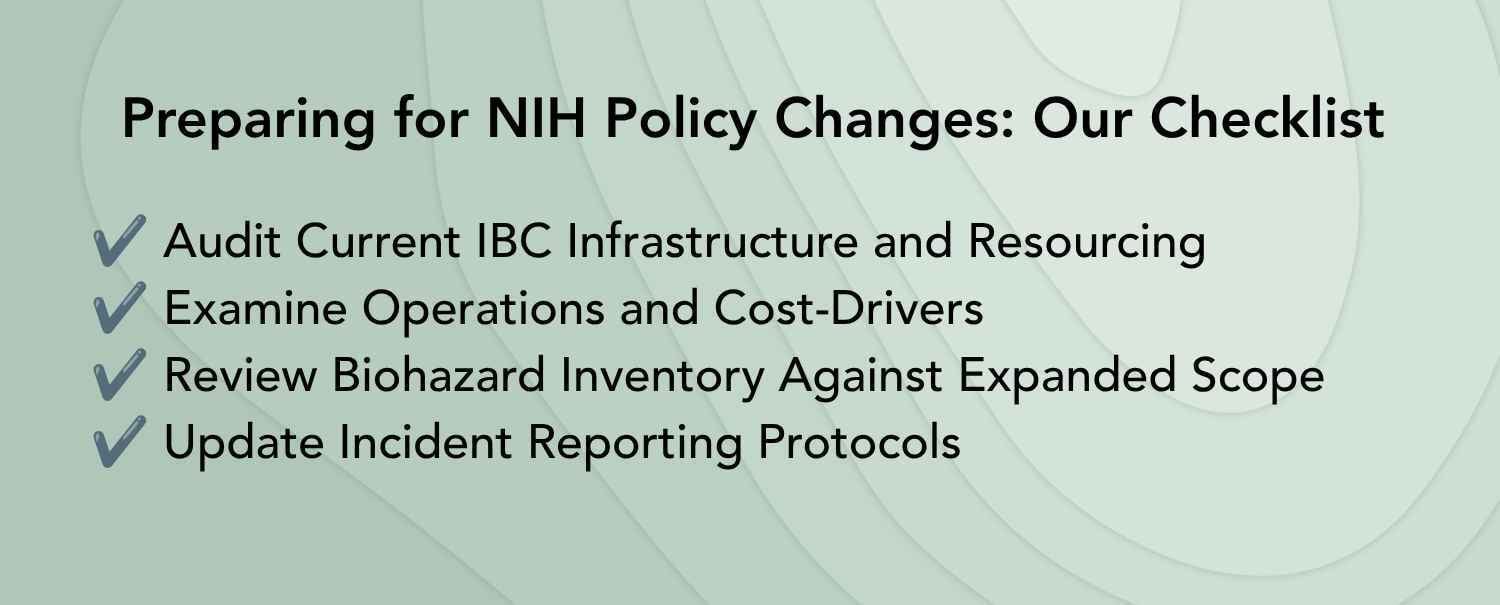
Audit Current IBC Structure and Resourcing
Document the IBC’s:
- Current membership
- Available expertise
- Meeting cadence
- Protocol volume
- Administrative support
- Average review time
Then model what happens if the volume of covered activity increases like in the case of a laboratory relocation or expansion, when facility design, waste programs, decontamination, permitting, and emergency response must scale with operations.
The goal is to identify the likely bottleneck before it affects a research schedule. Depending on the institution, that bottleneck may be credentialed expertise, committee availability, protocol administration, or the time required to document and communicate decisions.
Audit Operational Efficiency and Biosafety Cost Drivers
Use the resourcing review to quantify where expanded oversight could create avoidable cost. That includes:
- Committee administration
- Protocol-review cycle time
- Staff utilization
- Third-party support
- Training burden
- Waste disposal
The objective is to separate necessary biosafety investment from inefficiency so leaders can make informed build, buy, or share decisions before the policy is finalized.
Waste programs deserve particular attention because over-classification can slowly become one of the most expensive downstream effects of broader biosafety scrutiny. Institutions should compare current waste profiles against applicable state and local requirements, confirm which streams truly require regulated medical waste handling, and reinforce segregation practices at the point of generation. Accurate characterization helps prevent low-risk material from being managed as biohazardous waste simply because the broader research activity now receives more formal oversight.
Review Biohazard Inventory Against Expanded Scope
Map current and planned research against the draft policy’s definition of covered biohazards.
Include:
- Activities involving wild-type biological agents that cause human disease
- Genetically modified cells, viruses, or organisms
- Toxins
- Prions
- Self-aggregating proteins
- Cells or organisms containing risk materials
The review should also account for covered non-NIH-funded research conducted at an institution receiving NIH funding. The point is not to predict every final requirement—it’s to understand how much of the current research portfolio could move into formal biosafety oversight, where added review could affect operations, and whether waste classifications still match the actual hazard profile of each material stream.
Update Incident Reporting Protocols
Compare current incident-response procedures with the draft policy’s proposed reporting criteria and timelines. Confirm who owns:
- Initial notification
- Investigation
- Corrective action documentation
- IBC review
- NIH submission
- Public posting of the final report
A 24-hour reporting window is not the time to decide who is responsible. Institutions should establish those roles in advance, test the handoffs, and make sure investigators and laboratory personnel know how to escalate an event promptly.
Submit a public comment
The draft NIH biosafety policy public comment period is open through October 19, 2026.
Research institutions can comment on the:
- Proposed scope
- Risk-based oversight structure
- Reporting requirements
- Implementation feasibility
- Resource needs
- Areas where additional guidance would be valuable
Comments can be submitted through the NIH public comment portal. Submitted comments may become public, so institutions should not include proprietary, confidential, classified, or sensitive information.
Expanded Biosafety Oversight Requires a Resourcing Strategy
The NIH biosafety oversight modernization effort may seem like a compliance exercise, but it’s actually a resourcing issue. Broader scope raises three questions at once:
-
Whether the committee has credentialed capacity to review a wider portfolio
-
Whether waste classification tightens or drifts as covered activity grows
-
Whether protocol review keeps pace with research demand
Institutions can address all three now, while the policy is still in draft, at a lower cost than retrofitting their programs after the framework is finalized.
A skilled biosafety consultant can help institutions turn these readiness questions into practical action. The right partner brings technical depth, regulatory awareness, and operational perspective to evaluate IBC capacity, map covered biohazards, strengthen incident-reporting workflows, review waste classifications, prepare inspection-ready documentation, and build training programs that scale with research activity. As NIH moves toward broader biosafety oversight, experienced consulting support can help reduce compliance risk, avoid unnecessary program delays, and keep laboratory operations aligned with both safety expectations and research timelines.
If your institution is assessing how the NIH Biosafety Policy for Research Involving Biohazards could affect your program, now is the time to engage expert biosafety support and build a readiness plan before the final framework takes effect.
Frequently Asked Questions: