

The United States, on average, experiences about 5 chemical incidents per week. These incidents can lead to widespread fires, including a recent Illinois fire involving 15 pallets of trichloroisocyanuric acid that caused widespread emergency response, costing time and money and having a negative impact on human health and the environment. There’s a business case to lab fire safety, not just a human one. Maintaining safe and compliant, fire-proofed workplaces is only possible by combining fire prevention and suppression in tandem.
But fire prevention and suppression is no small task, especially in labs. These unique environments are a hot bed of fire hazards—ignitable chemicals, combustible liquids, and flammable materials meet complex housekeeping requirements, segregation demands, and ignition sources—and the results can be catastrophic if fire prevention techniques are not strictly followed.
Beyond just fire prevention, risks can compound if fire suppression guidelines and best practices aren’t met. The National Fire Protection Association (NFPA), local fire departments, and other governing bodies outline strict codes and standards that dictate the ways labs and facilities can keep safe if a fire were to occur.
The multi-faceted needs for fire prevention and suppression require close governance, and often, many operations and lab managers fail to fully understand their obligations as they relate to lab fire safety—or how to keep teams fully safe onsite.
Table of Contents
Lab Fire Safety: Key Takeaways
How to Prevent Laboratory Fires
Fire Suppression Standards and Best Practices
Lab Fire Safety: Key Takeaways
- Laboratories are hotbeds for fire hazards
- Lithium-ion batteries cause fires that are hard to contain and can quickly become dangerous
- Laboratories are held to guidelines by the National Fire Prevention Association (NFPA) and others
- Lab fire safety involves both fire prevention and fire suppression techniques
What Causes Lab Fires?
No lab is immune to fire risk—in fact, the very nature of lab work means that fire hazards abound. Some of the most common lab fire hazards include:
Lithium-Ion Batteries
Rechargeable lithium-ion batteries are a fast-growing and incredibly dangerous laboratory fire hazard. When disposed improperly, exposed to high temperatures, or physically damaged, the volatile electrolytes in lithium-ion batteries can release flammable gases that can quickly ignite into fires.
Where Lithium-Ion Batteries are Found In Labs
Lithium-ion batteries can be found in labs within:
- Small-scale machinery like handheld pipettes, analytical meters, and centrifuges
- Analytical equipment like computers, laptops, and tablets
- Employee cellphones or personal devices
- Hybrid or electric transportation devices
Lithium-Ion Battery Fires: By the Numbers
According to a March 2026 technical analysis from the National Institute of Standards and Technology (NIST), there have been roughly 198,000 lithium-ion battery fires in the United States since 2011. The incidence of fires tied to electric and plug-in hybrid vehicles are growing at a rate of about 45% annually. These numbers indicate the low end of the real count, as some lithium-ion batteries may go unreported.
In thickly settled regions, this can compound risk. In 2023, New York City's fire department logged 268 lithium-ion battery fires, resulting in 18 deaths; Toronto saw a more than 200% increase in battery fire incidents since 2022. Especially because these regions are rife with lab activity, any fire that breaks out runs the risk of building and building, expanding risk overall and resulting in massive safety and compliance dangers.
Lithium-Ion Fires Behave Differently
Fire suppression is difficult for lithium-ion fires. A lithium-ion cell that’s damaged, counterfeit, overcharged, or exposed to excess heat can enter a chain reaction known as thermal runaway. During thermal runaway, internal temperature and pressure escalate faster than containment methods can be deployed. These fires tend to ignite with little warning, burn hotter than an ordinary fire, and cut potential escape time down as compared to a traditional fire. And, because of the materials that comprise these batteries, when they burn they emit mass amounts of toxic vapors during decay and cell burn off.
Flammable and Combustible Liquids
Flammable and combustible liquids are used often in labs; acetic acid, ethanol, and others can be used to clean and sanitize lab spaces or in experiments and manufacturing processes. These liquids can release vapors that can quickly catch on fire or, when held near a flame, may ignite and burn quickly and uncontrollably.
Improper Chemical Storage and Segregation
If chemicals are stored improperly, leaks can occur—creating fodder for ignition. Or, incompatible chemicals can mix together and cause explosive or other reactive effects, causing fires.
Ignition Sources and Electrical Equipment
Electrical equipment throughout a lab can cause hidden ignition sources if not properly maintained. Loose or frayed wires can catch vapors or liquids and quickly cause uncontrollable fires. The same can be true of other onsite ignition sources—if a researcher uses a lighter to ignite a Bunsen burner, for example, but is near flammable vapors, a large explosion or fire could occur.
Poor Housekeeping and Waste Accumulation
Facility waste accumulation is doubly risky—built up wastes increase solvent leak and interaction risks, and block exits for onsite team members trying to escape the ensuing fire. This poor housekeeping can also block emergency exits and emergency equipment, meaning that not only will team members not be able to escape fires—but response will be significantly delayed as life- and property-saving equipment can’t be easily reached.
Wildfire Risk to Laboratories
While a less common risk, laboratories located in wildfire-prone locations risk tangential damage if wildfires near their facility. The facilities may take more damage if other fire hazard risks are not mitigated.
How to Prevent Labratory Fires
Fire prevention techniques include:
Maintain an Accurate Chemical Inventory
All downstream compliance and safety needs—Maximum Allowable Quantity (MAQ) calculations, chemical storage planning, and permitting—depend on knowing what’s actually onsite. A shared, cloud-based chemical inventory management system helps inform procurement and onsite teams about lab fire risk, storage needs, and necessary procedures.
Review Maximum Allowable Quantities
Check each laboratory unit’s chemical volumes, including waste, against its specific hazard classification’s MAQ limits and floor plan dictations. A strong chemical inventory management system, as described above, is what makes MAQ compliance a realistic ongoing effort vs. a once-a-year scramble.
Healthcare Lab MAQ Limits
For Healthcare facilities, there’s an added constraint: Class C units are capped at 50% of the standard allowable limit for ignitable liquids.
Evaluate Chemical Storage Practices
Review all chemical storage practices across labs and the entire facility. Confirm no hazardous chemical or waste container exceeds 20 liters/5 gallons, that nothing is being stored inside a fume hood, and that unattended fume hood sashes are fully closed. These are the checks that catch the “wherever there was room” storage pattern before it becomes a spill.
Conduct Routine Lab Fire Safety Audits
A code update or a new hire is not the only trigger for a review. Scheduled walkthroughs, using the same checklist every time, are what catch drift—the cylinder that migrated back into the lab, the cabinet that quietly filled past capacity.
Assign Clear Responsibility for Corrective Actions
An audit finding with no named owner and no deadline tends to still be open at the next audit. EHS should hold final approval authority on hazardous chemical purchases and storage decisions; procurement, facilities, and lab leads each own a defined slice of the follow-through.
Fire Suppression Standards and Best Practices
There are some best practices and actual fire suppression standards that can help improve a safe, effective, and compliant response if a fire were to break out.
Fire Suppression Standards
Numerous standards exist, from various regulatory agencies, that hold organizations accountable to fire suppression guidelines. As such, laboratory fire code compliance is crucial to avoid fines and maintain good standing with the Occupational Safety and Health Administration (OSHA), local and regional fire departments, the National Fire Prevention Association (NFPA), and others.
The National Fire Prevention Association (NFPA) is the primary guidance source for lab fire suppression. Its requirements augment the base fire codes for the type of occupancy.
At a minimum, NFPA requires considerations for:
- Electrical safety
- Life safety and egress routes
- Building design
- Fire equipment like fire sprinklers and fire alarms
- Fire department staffing and operations requirements
Local, state, regional, and other guidelines may also be enforced, more stringently, especially in larger, more densely populated “Danger Zone” areas like New York City or Boston.
Most laboratories sit at the intersection of several NFPA standards. NFPA 45, the “Standard on Fire Protection for Laboratories Using Chemicals,” is one of the most prevalent for labs.
How Does NFPA 45 Regulate Labs?
NFPA 45 is a set of codes that provides safety and fire protection requirements for laboratories using hazardous chemicals. It includes guidelines around:
- Laboratory classification, based on the facility’s hazardous materials storage
- Lab design and construction, including elements like:
- Fire protection ratings of doors and walls
- Distance to exits
- Means of egress and evacuation routes
- Quantities of hazardous materials allowed onsite
- Secondary egress routes
- Chemical collection and disposal
- Control areas
- Chemical storage and MAQs, including for hazardous chemical classifications of different type and volatility and for diversity of storage containers
- Fire detection and suppression systems, like:
- Sprinklers
- Smoke detectors
- Fire doors
- Fire walls
- Ventilation and fume hood use requirements
- Emergency planning, including for:
- Safe building evacuation and reentry
- Equipment and ventilation shutdown
- Firefighting roles
- How to handle non-fire chemical hazards
- Training and employee responsibilities, including
- Fire safety procedures
- Emergency Action Plans
- Lab hazards
- Appropriate PPE use
- Adherence to Occupational Safety and Health Administration (OSHA) regulations
- Chemical hygiene training
- Inspections and maintenance, including annual inspections at a minimum
What Other NFPA Codes Can Impact Lab Fire Safety?
NFPA 45 sets the baseline for laboratories using chemicals, but it doesn’t operate in isolation. Depending on a lab’s occupancy, hazard class, and the materials it stores, several other NFPA standards can apply at the same time—and an Authority-Having Jurisdiction (AHJ) will typically expect a facility to satisfy all of them, not just the one that means “laboratory” by name.
| NFPA 1 |
NFPA 1: Fire CodeNFPA 1 is the broad, umbrella fire prevention and protection code that most jurisdictions adopt as their baseline fire code. It covers general requirements—means of egress, fire department access, permits, hazardous material storage limits, and building fire protection systems—that apply to a facility as a whole, not just its laboratory spaces. NFPA 1 fills any NFPA 45 gaps. |
| NFPA 30 |
NFPA 30: Flammable and Combustible Liquids CodeNFPA 30 governs the storage, handling, and use of flammable and combustible liquids outside the specific context of a laboratory unit—bulk storage rooms, flammable liquid cabinets, tank storage, and dispensing operations. A lab that stores solvents beyond its in-unit MAQs is very often moving into NFPA 30 territory for the overflow. |
| NFPA 30B |
NFPA 30B: Code for the Manufacture and Storage of Aerosol ProductsNFPA 30B sets classification, storage, and warehousing requirements for aerosol products based on their heat of combustion—a narrower cousin of NFPA 30 for labs and adjacent stockrooms that keep aerosolized solvents, lubricants, or reagents on hand. Aerosol quantities beyond a lab’s in-unit limits typically need to satisfy NFPA 30B’s Level 1-3 classification and storage-array requirements alongside, or instead of, NFPA 30. |
| NFPA 101 |
NFPA 101: Life Safety CodeNFPA 101 sets the means-of-egress and general life safety requirements tied to a building’s occupancy classification. As NFPA 45 itself makes clear for healthcare labs, a lab unit’s hazard class determines whether NFPA 101 treats it as an industrial, educational, or business occupancy—which in turn shapes exit access, travel distance, and fire-rated separation requirements. |
| NFPA 400 |
NFPA 400: Hazardous Materials CodeThe NFPA 400 Hazardous Materials Code is a consolidated code covering the storage, use, and handling of hazardous materials across many hazard classes—oxidizers, corrosives, unstable reactives, and more—including control area concepts and MAQs that closely parallel the ones NFPA 45 sets for laboratory units. Facilities with hazardous materials outside the lab, like in a central chemical storeroom, frequently need to satisfy both NFPA 400 and NFPA 45. |
A lab fire code compliance review that stops at NFPA 45 is an incomplete review. Any laboratory fire suppression and safety program should map its chemicals, storage areas, and occupancy types against all of these standards together. A violation under any one of them is a violation under the AHJ’s inspection regardless of which code technically “owns” the issue.
Fire Suppression Best Practices
Besides compliance with NFPA and other guidelines, labs can utilize some fire suppression best practices to improve fire safety.
Evaluate Fire Protection and Life Safety Systems
Confirm ventilation runs continuously under normal conditions and that there’s a documented shutdown procedure if exhaust systems go down. Cross-check each lab unit’s hazard classification against its NFPA 101 occupancy type to make sure egress and separation requirements actually match how the space is classified.
Review Training and Emergency Procedures
For any experiment or process that uses hazardous materials, confirm a documented hazard risk assessment, a safety briefing, personal protective equipment (PPE), and a safety barrier are actually in place—and that instructors or lab leads are trained in fire safety procedures, Emergency Action Plans (EAPs). These emergency preparedness and response plans can mean the difference between rapid and effective emergency response and an injury-producing, out-of-control fire event.
Lab Fire Safety Checklist
Here’s a working version of the fire prevention and suppression checks to perform for holistic lab fire safety. Print it, walk the lab, and determine the state of your lab today.

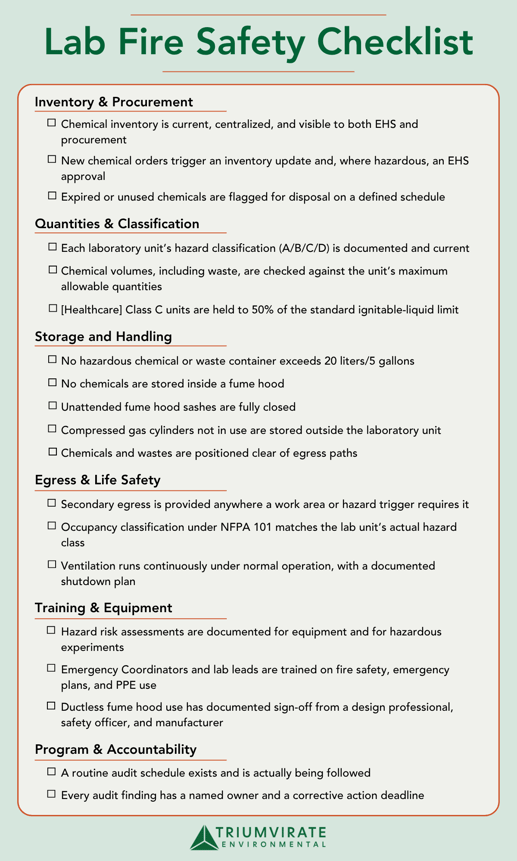
Lab fire safety needs to be a multi-faceted approach: fire prevention on the front end and fire suppression if a fire was to break out. Only if a facility has both facets under control can an organization be truly safe from fire hazards—and compliant with fire regulations. These are interlocking systems that take more than a single checklist.
Lab Fire Safety FAQ
What is Lab Fire Safety?
Lab fire safety comprises an approach to both fire prevention and suppression. It’s guidelines and best practices for preventing and responding to lab fires.
What is NFPA 45?
NFPA 45 is the Standard on Fire Protection for Laboratories Using Chemicals. Its most recent edition expanded its scope beyond life sciences and academic labs to explicitly cover healthcare laboratories as well.
Does NFPA 45 apply to my facility?
If your facility has a defined laboratory unit that uses chemicals—in life sciences, higher education, advanced manufacturing, or industrial QC—NFPA 45 very likely applies, alongside whichever of NFPA 1, 30, 101, or 400 also fits your occupancy and hazard materials.
How long does the NFPA check for compliance?
The NFPA does not check for compliance—but local fire marshals or insurance agents may. Typical inspections from fire departments occur every 1-3 years depending on the jurisdiction and occupancy classification. Insurance agents may inspect your facility while changing policies or after a large emergency event.
What is a maximum allowable quantity (MAQ)?
An MAQ is the ceiling on how much of a given hazard class of chemical can be stored or used in a laboratory unit, or a control area, before additional fire protection or separation requirements kick in. Chemical waste counts toward that ceiling, not just chemicals still in active use.
Do I need a secondary egress route?
It depends on the work area: an explosion hazard that could block escape, a Class A unit work area over 500 square feet, a Class B, C, or D work area over 1,000 square feet, or a large cryogenic or compressed gas container positioned where a release could block egress, all trigger the requirement on their own.
What happens if our fume hood ventilation goes down?
Affected laboratory operations need to stop until ventilation is restored, and any hazardous materials in use need to be safely secured or stored in the meantime; continuous ventilation isn't optional under normal operating conditions.
How often should we audit our lab fire safety?
There's no single number that fits every facility, but routine, scheduled walkthroughs using a consistent checklist—rather than only reacting to an inspection or a code update— are what catch quantities and storage practices drifting out of compliance between EHS audits.
How is NFPA 45 different from NFPA 1, 30, 30B, 101, and 400?
NFPA 45 is written specifically for laboratory units using chemicals. NFPA 1 is the general fire code a jurisdiction adopts as its baseline; NFPA 30 governs flammable and combustible liquids outside the lab unit context; NFPA 30B sets classification, storage, and warehousing requirements for aerosol products; NFPA 101 sets means-of-egress and occupancy-based life safety rules; and NFPA 400 consolidates hazardous materials storage and control-area requirements across hazard classes. Most labs need to satisfy several of these at once.
Who should have final approval over hazardous chemical purchases?
EHS should hold final approval authority for hazardous chemicals, ideally supported by the same inventory data procurement is using to place the order—so the approval happens before the chemical arrives, not after.
What are the penalties for non-compliance with fire safety regulations?
Penalties for non-compliance with fire safety regulations will vary based on the regulation being violated. Typical penalties can reach $1,000 per day or $5,000+ per day for severe or repeat offenses.
Who needs to consider lab fire code requirements?
Any lab facility needs to consider lab fire code requirements, including:
- Life Sciences and pharmaceutical laboratories
- Healthcare laboratories
- Higher Education and research laboratories
- Advanced Manufacturing laboratories
- Industrial and quality-control laboratories
Risks are typically greatest in labs that use flammable solvents, chemicals, and cultures—like cell research labs.