



Triumvirate Environmental

Questions?

Subscribe by Email

Download E-Book: Managing Interim Life Safety Measures (ILSM) in Healthcare Construction

Healthcare Best Practices Blog

Current Articles | RSS Feed RSS Feed

The Risks/Rewards associated with a hospital organization contracting with one provider for the management, collection and disposal of all of its waste-streams.

 | Submit to Digg digg it | Add to delicious delicious | Submit to StumbleUpon StumbleUpon | Share on Facebook Facebook | Share on Twitter Twitter | Share on LinkedIn LinkedIn 

By Bob Shuman, National Corporate Healthcare Director

Hospital organizations are now being sought after by some Waste Providers to "bundle" all of their waste-streams under one contract. This one-size fits all concept has certain risks and rewards that should be examined closely. This notion is becoming particularly popular with Hospital Senior Management. Let's discuss some of the implications of this concept, now.


Perceived Rewards - One provider, one invoice, one contact person, one culpable party when things go "bang in the night", one-stop shopping. Sounds good on paper...and may be good for the bottom line ("may" being the operative word).


Potential Risks -
No one waste provider manages, expertly, all waste-streams. No one waste provider actually services all waste-streams without "brokering" some portion of the business. No one waste provider can deliver technical and regulatory guidance on all waste streams.


So, at the end of the day you have to ask yourself, does convenience outweigh compliance?


It's your call...more to follow.

Proper Labeling of Chemicals

 | Submit to Digg digg it | Add to delicious delicious | Submit to StumbleUpon StumbleUpon | Share on Facebook Facebook | Share on Twitter Twitter | Share on LinkedIn LinkedIn 

By Steve Todisco, Senior Healthcare Account Manager

If you work in any field that pertains to hazardous waste management in any region of the United States, and also in any niche; you are bound by a few sets of rules. And by a few I mean a lot more than a few. Some of those rules are simple to follow and some of them are not. In the following paragraphs I am going to give you the keys to giving your hazardous waste program a good old compliance boost! (For those with a weak heart you might want to turn back now).

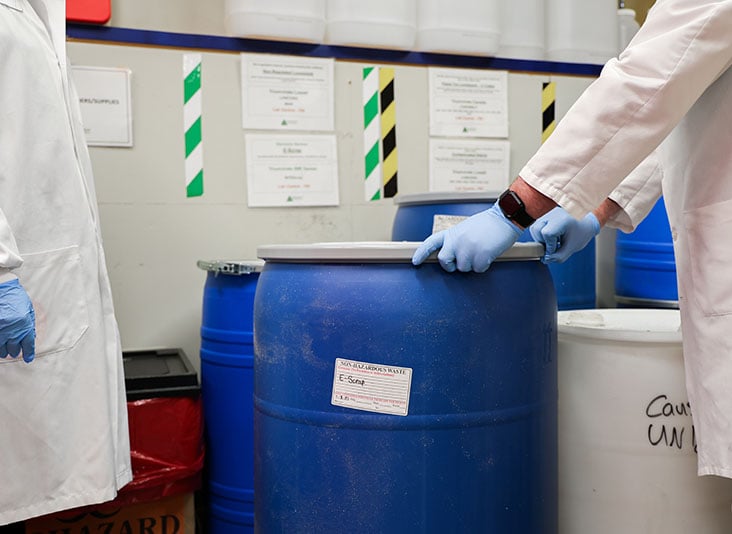
The proper labeling of chemicals in the form of labeling for hazardous and non-hazardous waste will take you very far in the world when it comes to being subjected to a full force inspection. Each state has it’s own special rules but you can boil it down to a few specific easy to follow items:

• The words hazardous waste

• Full chemical name with no chemical formulas or abbreviations

• Properly checked off hazard classes (Toxic, Ignitable, Corrosive, Reactive)

• A date when the container has been “deemed” full by its owner

Some states won’t require all of the above to be followed, but some states will (for a complete listing of what your state requires – Please go to your state specific website).

When it comes to non-hazardous waste the most important thing is that regulators know and understand visually that the waste in question is actually non-hazardous waste. With the simple creation of a label that states what the waste stream is and the words non-hazardous you can avoid questioning.

These are both state and federal requirements so make sure that your labeling your hazardous and non-hazardous waste appropriately because it accounts for a large percentage of violations that we see on a day to day basis. Simple training on this matter will help you avoid writing a large paycheck to your favorite regulatory institution.

As always if you have any questions, please feel free to call me at 339-226-0524.

Ambulatory Care

 | Submit to Digg digg it | Add to delicious delicious | Submit to StumbleUpon StumbleUpon | Share on Facebook Facebook | Share on Twitter Twitter | Share on LinkedIn LinkedIn 

By Steve Todisco,  Healthcare Account Manager

How many of you are familiar with pharmaceutical waste management, and also emergency showers in the emergency department?

In the world of pharmaceutical waste there are many locations that usually have waste that needs to be picked up and disposed of properly. Areas like the pharmacy, nursing units, Emergency Room, ICU, etc. Did you know that the ambulances routinely give medication routinely in route to the hospital? They typically generate a small amount of pharmaceutical waste that more often than not get’s mishandled. One simple way to avoid issues with local, state, and federal regulatory agencies is to provide a proper pharmaceutical waste container for the guys and gals that complete your ambulatory care upon the checkout of a particular patient they have cared for (even though it was a short time). The waste you will find could fall into many categories like biomedical waste, hazardous chemical “pharmaceutical waste”, and non – hazardous waste as well. Be sure to include this outlying area usually within the ED as an accumulation area and complete your required inspections and assessments.

The other area typically missed also within the emergency department is known as an emergency shower. Or a decontamination shower “Decon shower”. These showers are used to decontaminate potentially contaminated and contaminated patients as they get admitted to the emergency department. This area is typically drained to an underground storage tank (UST). Now depending on what your wastewater permit allows for discharge you might have to have this tank analyzed and pumped off for disposal prior to allowing for discharge. Another unfortunate use of an area such as this is on occasion in the winter time (if you have snow in your area!) these wheeled gurney’s (hospital beds) which will accumulate sand and salt from the outdoor activities and get cleaned in your Decon shower because it is central to the outside door. Same deal here if your discharge permit has limitations on what you can discharge you might want to look into if this practice is happening at your facility.

As always if you have questions please don’t hesitate to contact me.

Pharmaceuticals in the Drinking Water - Regulatory Compliance and Social Responsibility

 | Submit to Digg digg it | Add to delicious delicious | Submit to StumbleUpon StumbleUpon | Share on Facebook Facebook | Share on Twitter Twitter | Share on LinkedIn LinkedIn 

By Bob Shuman, National Healthcare Director

Many hospital organizations today are struggling internally with the dilemma of meeting the regulatory standards for the management, collection and disposal of pharmaceutical waste. This predicament is further complicated with both the uncertainty of the direction E.P.A. is headed with its adoption of its proposed universal waste rule, as well as the harsh reality that many pharmaceuticals developed post-RCRA are far more dangerous to human beings, wildlife and the environment than those currently regulated (and enforced).

Given the latter issue related to those post-RCRA pharmaceuticals, the conundrum arises as to "how much" of the pharmaceutical band-width a hospital should be prepared to collect to achieve both compliance with applicable regulations, and, to also adopt the "socially responsible" position that promotes the preservation of our waterways and drinking water.

To be sure, hospitals are faced with the quandary of where they each feel they should place themselves along the pharmaceutical collection continuum. This decision is not a simple one; it brings to bear questions related to cost, training, time and resource allocation, to name just a few considerations. In the end, there is no "one" best solution; however, each hospital must take the plunge into the water soon, no matter how cold it may be, at first.

Familiar with a lab pack?

 | Submit to Digg digg it | Add to delicious delicious | Submit to StumbleUpon StumbleUpon | Share on Facebook Facebook | Share on Twitter Twitter | Share on LinkedIn LinkedIn 

By Steve Todisco, Senior Healthcare Account Manager

For those of you who routinely ship waste off-site for hazardous waste disposal you should be familiar with what the term lab pack means. In order to understand what a lab pack is we should quickly outline the different types of ways that most people typically ship waste off of their site for hazardous or non- hazardous waste disposal. There are typically 3 major types of overall ways to ship waste off-site: Bulk, Non-Bulk, and Lab Pack.

Bulk shipping is shipping waste in larger containers that exceed 119 gallons of waste and is usually utilized for shipping in tanks, tanker trucks, and totes.

Non – Bulk waste shipping can include the shipment of a 55 gallon drum of liquid such as oil, or solvents. These containers might look and feel like a bulk container and they are often referred to that way but because they fall under the 119 gallon requirement we can call these non-bulks.

This brings us to the term lab pack. Lab packing is a method of shipping smaller inner containers inside a larger outer container. This allows companies like ours to be more efficient when shipping “like” materials. If you had several smaller containers that all were intact and contained within their own primary container than these items could be placed into a drum that is equal or lesser than 55 gallons and “lab packed”. Other things like packing material would also fall under the requirements of being added to this lab pack drum. Don’t forget that there are specific requirements for the amount of packing material required in each specific size drum per D.O.T regulations.

By shipping “like” things together you will be utilizing shipping names in the regulations like Waste flammable liquids n.o.s or (Not otherwise specified). This means that the shipping name that best fits all of the materials involved isn’t a specific single item like Waste Acetone, or Waste Methanol. Instead it could include “like” items such as methanol, acetone, and Isopropanol all in the same outer container.

Remember that “lab packing” falls under specific rules and exceptions so only highly trained individuals should undertake these tasks. Combining bottles of chemicals in the same outer container can be dangerous if not done correctly.

If you have any questions, please feel free to contact us here at Triumvirate.

Do you really know (or want to know) where your RCRA pharmaceutical waste goes once it leaves your hospital?

 | Submit to Digg digg it | Add to delicious delicious | Submit to StumbleUpon StumbleUpon | Share on Facebook Facebook | Share on Twitter Twitter | Share on LinkedIn LinkedIn 

By Bob Shuman, Corporate Director of Healthcare

Assuming that it doesn’t go down the drain (and that would be disastrous), it has to go somewhere once it is segregated, packaged, labeled, manifested and sent on its way.

Where it’s sent, and how it is transported, however, largely impacts the extent of your cradle to grave liability for the inappropriate disposal of EPA/State regulated hazardous waste.

Neither you, nor your organization may ever be called to task for non-compliance, but, then again, you may. And, who really wants to go to sleep at night with the Sword of Damocles hanging over his or her head? Gravity-based fines or horizontal stripes are generally not welcome outcomes.

To begin with, there are DOT compliant transporters who are licensed and trained to ship hazardous waste, and then there are two guys with a truck and a dolly who claim they can do it “cheaply”. Have you checked your transporter’s DOT record recently?

And then there’s the small matter as to where the stuff ends-up…is it being incinerated by a reputable end-disposer who complies with the very stringent regulations promulgated by the federal, state and local authorities, or, is it being shipped to a land-fill in New Jersey to reside with Jimmy Hoffa?

Or perhaps, it’s being sent for reverse distribution…but what happens to it if you never receive a credit? Where does it go and what happens if ends-up in the wrong place?

You should really know where your pharmaceutical waste goes…not knowing could result in a bad headache and the need for some pharmaceutical “assistance” (oh-oh, isn’t this where we began?).

“To Inspect or not to inspect that is the question (and do I document?)”

 | Submit to Digg digg it | Add to delicious delicious | Submit to StumbleUpon StumbleUpon | Share on Facebook Facebook | Share on Twitter Twitter | Share on LinkedIn LinkedIn 

By Steve Todisco, Senior Healthcare Practice Account Manager

I have been asked the question as of late whether or not inspections are required for different things. Now of course depending on the state you work in and the requirements around a particular area of environmental management than you will need to get pretty specific around whether or not you are required to inspect things like Satellite accumulation areas for hazardous waste, Main accumulation areas, tanks, etc.

On the subject of inspections that you are not required to complete, people ask me all the time whether or not they should inspect (and document) their findings. In today’s age where regulations and their regulators have such varying opinion in makes all the sense in world to inspect and log all of your findings. I mean this from the perspective of having a great program. Without inspections you risk not knowing the full detail and quality of a particular program. The overall goal is to have true compliance right???? Without inspecting, documenting, analyzing, and deciphering your areas of compliance you will never have a good idea on how well (or how poorly) you have made out.

Having the ability to track compliance and build on poor compliance is the key to what all regulators secretly want to see. If you have a mechanism in place and it is being followed to the highest standard than odds are you are not only going to have a truly compliant system, but if you have a slight mishap your likely to be able to put in place the needed steps to correct and better your individual program (and regulators will see that too).

Here in lies a new concept that’s not a new concept at all “creating a feedback loop”. Give yourself the opportunity to be able to take your results and either make changes if they’re poor results, or (and here is the better of the two) if they are great results pat yourself on the back and let people know.

Using good data like this gives you the opportunity to:

• Showcase your talents as a leader

• Acknowledge peers and co-workers

• Look good in front of your boss

• Obtain and maintain larger budgets based on the data you receive ( to get more done)

• Let the institution know that you are here to “do the right thing” and do it well

So all in all similar to what a Joint Commission inspector would say - “If it’s not documented, it hasn’t been done" – Is a good way to manage your inspection programs. Please feel free to contact me with questions anytime and about all topics.

Email: stodisco@triumvirate.com

Cell: 339-226-0524

How will the proposed EPA Universal Waste Rule change your collection program?

 | Submit to Digg digg it | Add to delicious delicious | Submit to StumbleUpon StumbleUpon | Share on Facebook Facebook | Share on Twitter Twitter | Share on LinkedIn LinkedIn 

By Matthew Teeter,  Healthcare Compliance Advisor

It is important to point out that the proposed universal waste rule for pharmaceuticals has not been passed. In the event that the rule is passed, it will still need to be adopted by individual states before these regulations can be implemented at your facility.

With the increased regulatory oversight on healthcare pharmaceutical collection, management and disposal, healthcare facilities have been tasked with developing regulatory compliant programs often with dated regulations. The Environmental Protection Agency (EPA) had an open comment period for the proposed regulations allowing the healthcare industry to voice their concerns and guidance around the subject matter.

In reviewing the proposed universal waste rule, some of the notable regulatory items of interest are as follows:

• “Hazardous pharmaceutical waste generators may elect to have their hazardous pharmaceutical waste remain regulated under the current Resource Conservation and Recovery Act (RCRA) generator regulations as set forth in 40 CFR 262, or may choose to manage their hazardous pharmaceutical wastes under the universal waste rule.”1

• “Specifically the universal waste rule does not distinguish between acutely hazardous P-listed wastes and other hazardous wastes.”1 This would allow generators the ability not to track P-listed weights and therefore not be concerned about if they are generating 2.2 pounds or greater per month.

• With the choice of managing pharmaceutical wastes under the universal waste rule, small quantity handlers would be able to generate 5,000kg or 11,000 pounds of all universal waste at one time.

• “Unlike the container requirements for other universal wastes, the proposed container requirements for pharmaceutical universal wastes do not include the requirement that containers be closed.”1 Manifesting, accumulation time limits, training and reverse distribution are also outlined within the proposed universal waste rule.

The proposed rule can be found at:

http://www.epa.gov/epawaste/hazard/wastetypes/universal/pharm.htm

1 Federal Register / Vol. 73, No. 232 – pgs 73520 - 73544

Have you done a hazardous waste determination on your institution's pharmaceutical waste?

 | Submit to Digg digg it | Add to delicious delicious | Submit to StumbleUpon StumbleUpon | Share on Facebook Facebook | Share on Twitter Twitter | Share on LinkedIn LinkedIn 

By Matthew Teeter, Healthcare Compliance Advisor

Healthcare pharmaceutical waste collection, management and disposal have come under state and federal scrutiny over the past several years. As with other generated wastes, it is essential that a hazardous waste determination be conducted on your institutions pharmacy formulary to identify the hazardous items required for collection. Waste determinations are not easy and it is not uncommon to see pharmacy formularies consisting of 1,500 0 3,500 items; the entire process can be quite cumbersome. It is important to have a knowledgeable party that understands hazardous waste regulations assist in the waste determination process and it helps if they have conducted a hazardous pharmaceutical waste determination in the past.

Remember that if a waste meets or exceeds a state and/or federal hazardous waste definition it must be collected, managed and disposed of as a hazardous waste by regulation. Some pharmaceutical wastes exhibit a certain characteristic, others have been specifically called out in the regulations as a hazardous waste in its unused form and even some empty acutely hazardous wastes requires to have empty containers collected.

In many cases it may not be as simple as looking at a particular medication’s name to determine whether or not it should be classified as hazardous. There are many components to today’s pharmaceuticals and more often than not some research is needed on a particular product.

These wastes are generated in not only the pharmacy, but also patient care units throughout hospitals. Assure that your institution has completed its hazardous pharmaceutical waste determination appropriately and that you are ready in the event of a state or federal inspection.

Multi-Media Survey – A Compliance Consideration for Your Hospital

 | Submit to Digg digg it | Add to delicious delicious | Submit to StumbleUpon StumbleUpon | Share on Facebook Facebook | Share on Twitter Twitter | Share on LinkedIn LinkedIn 

By Bob Shuman, National Corporate Director of Healthcare

Most hospitals today recognize the critical importance of complying with both the EPA and their State regulations directed at the lawful management, collection and disposal of hazardous waste within their facilities.

In a perfect world, hospitals would create a strategic plan, identify the appropriate human resources and fund an adequate budget to reach compliance; in fact, they would treat regulatory compliance as seriously as they do financial compliance. And why shouldn’t they…non-compliance, in any flavor, can be costly and involve both civil and criminal penalties.

But this is not a perfect world; many hospitals, in these challenging financial times, are struggling to prioritize and then fund their competing strategic initiatives. Budgets are already stretched, nerves are frayed and human resources are over-allocated.

What to do then about assessing environmental compliance?

One simple and straightforward solution is to engage a trusted industry expert and advisor (Triumvirate) to provide a multi-media survey of your environmental systems directly regulated by the EPA and your State authorities. This survey can be as narrow in scope as to review the programs established to manage RCRA related waste, or, be broadened to include compliance with the Clean Air Act, Clean Water Act and the other 3 – 4 major regulations promulgated by the EPA. This survey can often be crafted in a fashion such that there are no self-reporting requirements in the event that deficiencies are identified that may require correction or remediation.

In the end, your facility will get an environmental “check-up from the neck-up” from which go-forward planning and decisions can be intelligently made to move further along the compliance continuum. Its one giant step in the right direction for your hospital and, potentially for the people and communities you serve.

Please feel free to e-mail me at rshuman@triumvirate.com if you have any questions.

All Posts